
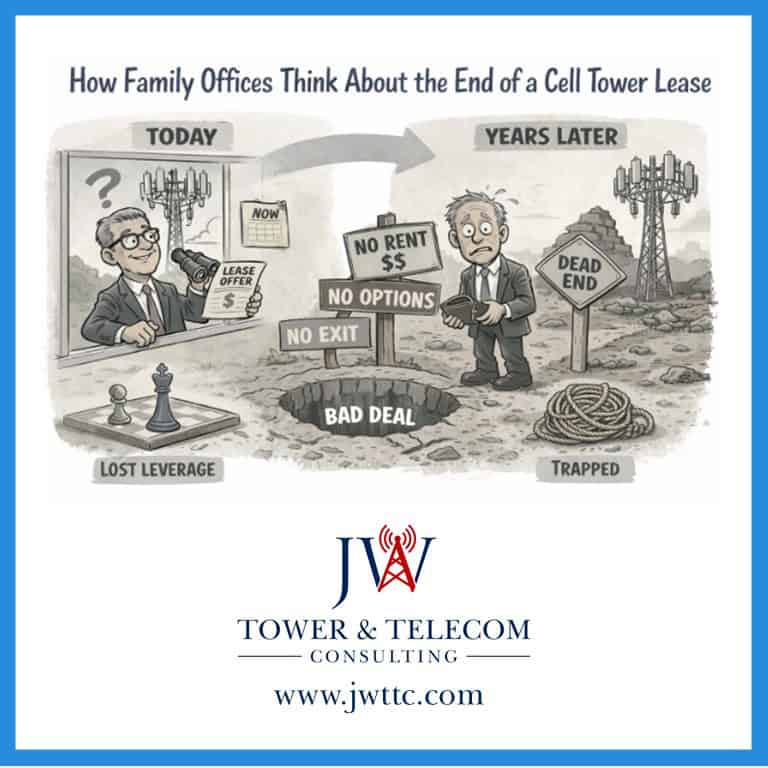
Most property owners approach cell tower leases from the present forward.
What’s the rent today? What are the escalators? When does the lease expire? Is there a right of first refusal? Revenue share?
Family offices do the opposite.
They model cell tower leases backwards. They start with how the asset is likely to end and work their way back to today’s decisions.
Start With the End, Not the Rent
Many family offices assume that every cell tower lease will eventually reach a decision point:
- A lease buyout offer
- A major extension or restructure
- Decommissioning or termination of the lease
- A sale of the underlying property
- A portfolio-level liquidity event
Instead of reacting when those moments arrive, they plan for them years, or even decades in advance.
That framing changes everything.
Exit Outcomes Drive Present-Day Strategy
When modeling a cell tower lease backwards, family offices ask:
- What outcome do we want to preserve as viable?
- What decisions today could eliminate that option later?
A lease that looks attractive on a cash-flow basis today may quietly undermine future exit value if it gives up too much control, flexibility, or leverage. This reminds us of a recent conversation with a friend who manages a family office. They purchased a building that had inherited both an AT&T and T-Mobile lease. In our wide-ranging discussion, they plan to potentially add floors to the building. It raises questions about how the leases are currently written. Who pays for temporary equipment relocation in this scenario? Is there a time limitation? It all ties back into the lease that controls the interest in the property.
Why Backward Modeling Leads to Different Decisions
This approach explains several behaviors that often confuse individual property owners.
Why Family Offices Decline “Attractive” Buyout Offers
A buyout can make sense, or it can permanently cap upside.
Family offices evaluate buyouts against future scenarios, not just current pricing. If a buyout removes optionality that could be more valuable later, they often pass, even if the number looks compelling today.
In that same conversation, they had an interest in utilizing the proceeds to lower the debt ratio on their property. A few years ago (without representation), they had what they believed to be an attractive buyout. When the closing documents came in, they weren’t going to assign just the two leases on the rooftop; there was a clause inserted that they would provide rights to the entire rooftop. Fortunately, our friend was able to spot this clause, which was not negotiated, and ceased proceeding with the transaction.
Why They Are Conservative With Extensions
Long extensions are powerful tools, but they’re also irreversible. Family offices assess whether extending now improves future leverage or simply locks in terms before the carrier’s reliance on the site fully matures. Another item to note is that most cell tower leases have generous cancellation notices already in their standard terms. If a tenant has unfettered termination in year 7 versus 17 versus 27, on paper an extension might look good, but not be quite what it seems.
Why They Don’t Optimize Every Negotiation
Pushing for maximum rent in every interaction can weaken long-term positioning.
Backward modeling prioritizes sustainable leverage over short-term wins.
Optionality Is the Core Metric
Family offices care deeply about optionality.
Optionality means:
- The ability to renegotiate when conditions improve
- The ability to monetize when pricing is favorable
- The ability to sell without friction
Every lease provision is evaluated through this lens.
Does this decision expand future options, or quietly close them?
The Cost of Forward-Only Thinking
Owners who model cell tower leases forward often:
- Optimize rent while sacrificing control
- Accept extensions that limit exit paths
- Take buyouts without understanding long-term tradeoffs
These decisions rarely feel costly at the time they’re made. The consequences surface years later, when options are constrained and leverage has quietly disappeared.
During our time at T-Mobile, I saw this play out firsthand. In one case, new property owners running an otherwise sophisticated business were surprised and frustrated to learn they would never receive cell tower rent. The prior owner had sold the lease for a lump sum in perpetuity, leaving the buyer with no ongoing consideration despite inheriting the physical presence of the equipment.
A basic title review would have revealed the encumbrance. A site visit, noting antennas mounted to the building, likely would have prompted further questions. The issue wasn’t complexity, it was visibility. By the time they realized the situation, there was no way to reverse it.
Thinking Like a Family Office
You don’t need a balance sheet full of assets to adopt this mindset. Property owners who start with the end in mind consistently make calmer, more disciplined decisions and tend to extract more value over the full life of the lease. Family offices evaluating lease buyout options should model the lump-sum against projected rent to determine the optimal path.
Final Thought
In cell tower leasing, the most important decision is rarely the one in front of you today.
It’s the one you’re unknowingly shaping for the future.
Family offices understand that value is created not just by what you negotiate—but by what you preserve.
Navigating the end of a contract requires a clear understanding of what happens when a lease expires, especially regarding whether the carrier is obligated to remove equipment or if the lease automatically transitions into a month-to-month holdover. This becomes a critical factor when evaluating what a cell tower lease buyout is, as the lump-sum value offered by investors is heavily dependent on the remaining years and renewal terms left on the agreement. These complexities are further magnified during estate planning, as cell tower leases in probate can become significant hurdles for heirs if the rights to future rent or buyout proceeds aren’t explicitly defined in a will.
JW Tower & Telecom Consulting advises property owners and family offices by helping them evaluate cell tower leases from the end backward—before leverage and optionality are lost.
