
US-36 Tech Corridor vs Residential Cell Tower Leases Broomfield
US-36 Tech Corridor vs Residential Cell Tower
Understanding the difference between US-36 tech corridor and residential cell tower leases in Broomfield, CO, matters because Broomfield’s geography creates two genuinely distinct cell tower lease markets within the same city — one anchored by the highest-value technology corridor in northern Colorado, and one serving one of the state’s most affluent residential communities. The financial outcomes and negotiation priorities differ meaningfully between these two profiles.
Side-by-Side Comparison — 2026
| Factor | US-36 Corridor / Interlocken Site | Residential Broomfield Site |
|---|---|---|
| Typical initial carrier offer | $2,000–$3,500/mo | $1,000–$2,000/mo |
| Well-negotiated range | $3,500–$7,000+/mo | $1,800–$3,500/mo |
| Signing bonus availability | Yes — $10,000–$25,000+ for tier-one sites | Typically not available; may be possible for coverage gap sites |
| Primary value driver | Tier-one corridor coverage, corporate tech campus demand | High-income residential demand density, coverage gap necessity |
| Colocation likelihood | High — multiple carriers competing for corridor coverage | Moderate — depends on coverage gap specifics |
| Right of first refusal impact | Significant — commercial property market value | Significant — high-value residential real estate market |
| Four-county legacy relevance | High — corridor leases most affected by jurisdictional confusion | Moderate — affects all pre-2001 Broomfield leases |
| Top negotiation priority | (1) Rent, (2) Signing bonus, (3) Colocation sharing, (4) Footprint | (1) Escalation rate, (2) ROFR removal, (3) Rent, (4) Access rights |
| Total 25-year value premium | 2–3× residential equivalent | Baseline |
Why the US-36 / Interlocken Premium Is So Large in Broomfield
The gap between US-36 corridor sites and standard residential properties in Broomfield is unusually wide — wider than the equivalent urban-vs-suburban gap in most other Colorado cities — for three compounding reasons:
Reason 1: The US-36 corridor is tier-one in the entire state. US-36 is not simply a major Broomfield road — it is Colorado’s most economically productive technology commute route, connecting the Denver Tech Center employment zone in the south to Boulder’s technology and university research community in the north. Carriers assign tier-one status to this corridor statewide. Broomfield properties along US-36 don’t just benefit from Broomfield market dynamics — they benefit from a statewide corridor premium.
Reason 2: The Interlocken corporate campus is the densest technology employment concentration in the northern Front Range. Oracle, as the city’s second-largest employer, Ball Aerospace, and dozens of technology and life sciences firms in a master-planned campus environment generate network demand that is qualitatively different from residential or standard commercial demand. The workforce density, the professional demographic, and the persistent workday demand pattern create a coverage requirement that carriers budget specifically for. Interlocken-adjacent sites are not “near a business park” — they are adjacent to a major carrier network investment priority.
Reason 3: The 1STBANK Center event demand amplifies corridor sites. US-36 corridor and Interlocken-adjacent sites that are also within the 1STBANK Center’s event-day coverage range carry an event-demand premium in addition to the corridor and campus premiums. The 6,500-capacity arena’s recurring events create demand spikes that carriers plan for in the same network areas served by the US-36 corridor installations. The combined effect is a usage-intensity premium that stacks on the already above-average corridor value.
Residential Broomfield — Above Average in Its Own Right
Broomfield residential properties are not standard Colorado suburban sites — the $125,055 median household income indicates above-average mobile data consumption per household, master-planned neighborhoods with consistent coverage demand, and a high-value real estate market where the removal of the right of first refusal is particularly important. Well-negotiated residential Broomfield leases at $1,800–$3,500 per month reflect above-average residential demand, even if they don’t approach the tier-one corridor values of US-36 sites. The escalation clause is especially important for residential Broomfield leases — in a market with $125,055 median income and above-inflation real estate appreciation, a 3% escalation clause captures significantly more long-term value than a 1.5% clause. Call (720) 295-5333 for a free consultation on any Broomfield property type.
Frequently Asked Questions
Do US-36 corridor properties get higher cell tower lease rates than residential in Broomfield, CO?
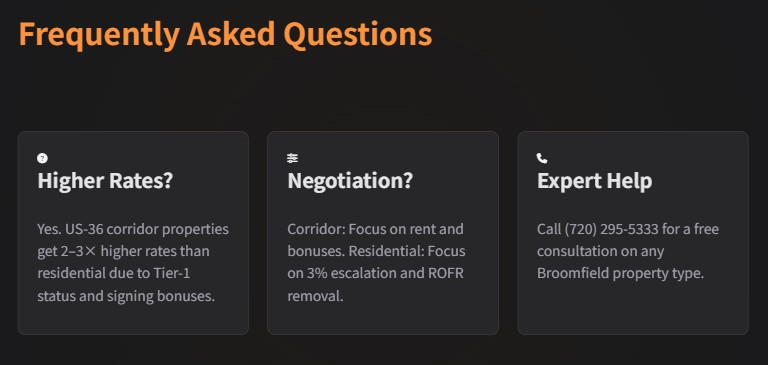
Yes, significantly — 2–3× the residential equivalent in well-negotiated agreements. The gap is wider in Broomfield than in most comparable Colorado markets because US-36 is tier-one statewide, Interlocken is the densest corporate tech campus in the northern Front Range, and signing bonuses are available for US-36 corridor sites that aren’t typically accessible for residential properties.
What negotiation priorities differ between the US-36 corridor and residential Broomfield leases?
US-36/Interlocken: prioritize rent maximization, signing bonus, colocation sharing, and footprint definition. Residential Broomfield: prioritize escalation rate (3% in a premium income market), ROFR removal, rent improvement, access notice requirements, and four-county legacy correction if pre-2001. Call (720) 295-5333.
About the Author
John M. Wabiszczewicz II is the founder of JW Tower & Telecom Consulting in Denver, Colorado. He holds a Juris Doctor from Roger Williams University School of Law (Bristol, Rhode Island) and a Bachelor of Science in Finance from Bentley University (Waltham, Massachusetts). John began his telecommunications career in 2007 at American Tower as an Asset Acquisitions Attorney in Greater Boston, negotiating lease extensions, capital leases, perpetual easements, and land purchases on the most strategically important cell site locations nationwide with annual spend exceeding $40 million. In 2010, he relocated to Colorado and became a Tower Acquisitions Representative for American Tower, where he acquired new cell tower assets, generating over $10 million in annual revenue. From 2013 through 2023, he led Regional Network Engineering and Real Estate for T-Mobile’s Denver Market, with operational responsibility across Colorado, Wyoming, South Dakota, Utah, Nebraska, and Kansas. He founded JW Tower & Telecom Consulting to represent property owners, drawing on the same insider knowledge he had previously applied on the carrier and tower company side. Review the firm’s BBB profile for business verification.