
Cell Tower Lease Consultant vs Real Estate Attorney: Who Handles What
You probably already know a good real estate attorney. She drew up the contract when you bought the property. She handled the title search when the easement question came up three summers ago. She is smart, careful, and returns your calls. So when the letter from American Tower, SBA Communications, or the carrier’s site acquisition firm lands on your desk with a 30-page lease stapled behind it, calling her feels like the obvious next move.
The short answer: A real estate attorney reads your cell tower lease for legal risk. A cell tower lease consultant reads it for value. Both matter, and the clauses that cost you the most money are the ones that sit in the overlap, cell tower lease consultant vs real estate attorney. The cleanest outcome comes from a practitioner who can perform both functions in a single engagement, which is what JW Tower & Telecom Consulting exists to do. Founder John M. Wabiszczewicz II holds a Juris Doctor from Roger Williams School of Law and spent 15 years inside the industry before switching sides: 5 years at American Tower as an Asset Acquisitions Attorney, then 10 years at T-Mobile leading Regional Network Engineering and Real Estate for the Denver Market across six states. Call (720) 295-5333 for a free consultation.
Here is the problem with just calling the attorney you already know. A cell tower lease is not a real estate transaction. It looks like one. The document is titled “Ground Lease Agreement.” It references parcel lines, easements, and access rights. Your attorney will recognize 60% of the words on the page. But the 40% that is unfamiliar is where the money lives, and it was drafted by lawyers who negotiate these agreements a thousand times a year, while landowners negotiate only one.
You negotiate one. They negotiate thousands. That asymmetry is the whole game.
What a Real Estate Attorney Does With Your Cell Tower Lease
A competent real estate attorney performs a specific set of functions well. She reads the lease for legal risk. She confirms the property description matches your deed. She checks whether the access easement the carrier wants will conflict with existing easements on the parcel. She looks at the indemnification language and pushes back if it exposes you personally. She verifies the insurance requirements and the notice provisions. She ensures the lease survives a property sale and protects you if the tenant defaults.
This is real legal work, and it has real value. If your cell tower lease goes into litigation five years from now, you will be glad a qualified attorney drafted the language that protects you. Most of the standard forms from major wireless carriers have been through hundreds of litigation cycles on the carrier’s side. The clauses that govern default, assignment, indemnity, and force majeure have been stress-tested in carrier-favorable ways. A good real estate attorney recognizes those patterns and rebalances them.
What a real estate attorney typically cannot do is tell you whether the rent number is fair.
That is not a criticism of the profession. It is a function of what attorneys are trained to evaluate. The rent number is a market question, and the cell tower lease market is not visible from inside a law firm. Comparable rents are not published. The carrier’s internal valuation model is not in a case reporter. The question of whether a $1,800-per-month offer in Jefferson County is reasonable, generous, or an insult depends on whether the site sits within a coverage gap, whether the carrier’s 2026 capital plan targets that exact grid square, and whether there is a second carrier already collocated on the structure. Those are operational questions. Your attorney will not have answers to them unless she has specifically worked inside the wireless industry.
What a Cell Tower Lease Consultant Does With Your Lease
A cell tower lease consultant reads the same 30 pages for a different purpose. The consultant is looking for value, which means evaluating each clause through the lens of its dollar value over the lease term. That shift in purpose changes what gets flagged, what gets negotiated, and what gets accepted.
A consultant reviewing a cell tower lease should be able to answer the following questions before recommending any action:
- What are carriers currently paying in this county for sites of comparable size, tenant mix, and coverage importance?
- Is the escalator structure in line with current market conditions, or is the carrier using a legacy 2% annual escalator at a time when the market is trending toward 3% or CPI-linked rates?
- Does the lease contain a Right of First Refusal clause, and if so, what is it quietly costing the landowner in future buyout scenarios?
- What does the assignment clause let the current tenant do without your consent, and how does that change the identity of who you are actually in business with five years from now?
- How do the termination rights favor the carrier, and what specific language tightens them in favor of the landowner?
- If a buyout offer came tomorrow, what multiple would this lease attract in today’s market, and what would it attract after the amendments a skilled negotiator would secure?
Those are the questions that determine whether you leave six figures on the table. A typical real estate attorney will not think to ask them because they are not legal questions. There are operational questions in the wireless industry that require insider experience to answer correctly.
The Clause-by-Clause Breakdown: Who Owns Which Section
A 30-page cell tower lease typically contains 25 to 30 numbered sections. Here is how the ownership of each section usually divides between an attorney and a consultant, assuming both have relevant expertise.
Attorney-Led Sections
- Definitions: Attorney reviews for precision and defined-term consistency. Consultant flags definitions that affect valuation (e.g., definition of “equipment” that does not include future 5G radios).
- Indemnification: Attorney-led. The carrier’s standard language often indemnifies the carrier broadly while narrowing the landowner’s protection. Attorney rebalances.
- Insurance requirements: Attorney-led. Consultant confirms the numbers match what carriers are actually carrying today.
- Notice provisions: Attorney-led. Consultant flags whether notice periods align with typical industry timelines (e.g., a 30-day cure period for an amendment request when the carrier’s internal process takes 90 days).
- Default and remedies: Attorney-led.
- Governing law, forum, and dispute resolution: Attorney-led.
Consultant-Led Sections
- Rent and rent escalators: Consultant-led. Attorney reviews for enforceability. The starting rent is the easiest thing to negotiate and the least important long-term variable. The escalator structure is the opposite: hardest to negotiate, most important over 30 years.
- Term and renewal options: Consultant-led. A 10-year term with four automatic 5-year renewals is a 30-year encumbrance, not a 10-year lease. Consultant models this out. Attorney confirms the renewal mechanism is legally enforceable.
- Premises description and equipment area: Consultant-led. Carriers routinely request larger premises than they need. A tight, specific equipment area protects your future development rights without altering the carrier’s economics.
- Assignment rights: Shared. Attorney reviews legal mechanics. Consultant addresses the industry-specific risk that the tenant you signed with will sell the lease to a counterparty you have never heard of within five years.
- Right of First Refusal: Consultant-led with legal support. ROFR language can reduce a future buyout offer by $100,000 or more because no third-party buyer will invest in a bid that can be matched. A skilled consultant rewrites or removes it; a legal review confirms the rewrite is enforceable.
- Amendment and modification procedures: Consultant-led. This is where the carrier will return years later to request equipment. Tight amendment language captures future value for the landowner every time.
- Termination for convenience: Consultant-led. Carriers want broad termination rights. Consultant narrows them.
- Buyout and purchase option language: Consultant-led. If the carrier wants an option to purchase the leased premises, that option should be priced separately and narrowly.
- Access and utilities: Consultant-led. The specific access route, utility easement, and generator location are operational questions that affect your property use for decades.
Shared-Ownership Sections
Three sections genuinely sit in the overlap and require both disciplines to work together. The first is the memorandum or short-form lease that gets recorded in the county land records: the attorney drafts it, and the consultant confirms that what gets recorded matches the operational agreement. The second is any tax provision that allocates property tax responsibility between the parties: the consultant knows what carriers will and will not agree to pay; the attorney knows how to draft the allocation language so it holds up in an assessment dispute. The third is the subordination, non-disturbance, and attornment agreement, which binds your mortgage lender to honor the lease if you default: attorney drafts, consultant confirms the business terms are standard for the industry.
The Cost Comparison: Billable Hours vs Success-Fee Structure
The fee structure is where most landowners first feel the difference in how these two professions approach the same document.
A real estate attorney typically bills by the hour. A careful review and negotiation of a new cell tower lease will take 8 to 20 hours at rates that, in most U.S. markets, range from $275 to $550 per hour. You are paying for the attorney’s time regardless of the outcome. If the lease comes in at market rate with fair terms and no negotiation is needed, the bill still arrives. If the negotiation dramatically improves the deal, the bill is still the same. The attorney’s incentive structure is uncorrelated with your financial outcome.
A cell tower lease consultant, when the business is structured on success fees, only gets paid when your position improves. JW Tower & Telecom Consulting operates on this model. For lease negotiations and amendments, the firm earns a success fee tied to the new revenue secured through advocacy. For cell tower lease buyouts, compensation is a percentage of the transaction value. The initial consultation is free. No success, no fee. That structure does three things at once. First, it eliminates the risk that you will spend money on professional fees only to learn that the offer in front of you was actually reasonable. Second, it aligns the consultant’s incentive with yours: the consultant wins when you win. Third, it changes the conversation from “will I pay to find out” to “what do I have to lose by having this looked at.”
The U.S. Federal Communications Commission’s Competition and Infrastructure Policy Division publishes the national-level policy framework that shapes how carriers price these deals. A consultant working the valuation side of a cell tower lease should be able to tie their recommendations back to the infrastructure policy environment that drives carrier deployment decisions. That is a very different conversation from the one that takes place in a typical real estate attorney’s office.
When You Need One vs the Other vs Both
The honest answer depends on the situation in front of you. Here is a practical framework.
Hire only a real estate attorney when: the deal is already substantively negotiated, the rent and terms have been independently benchmarked, and you need a qualified legal review to confirm the paper holds up. This is rare in practice. Most landowners do not have a reliable benchmark for rent, which is why “hire only an attorney” usually leaves money on the table that the attorney’s fee does not cover.
Hire only a cell tower lease consultant when: the engagement is a cell tower lease buyout evaluation, a lease amendment request where the carrier is asking to add equipment in exchange for a modest one-time payment, or an estate question where you need to understand what the lease is worth before distributing it among heirs. In these scenarios, a consultant with industry experience conducts the value analysis in full, and a separate legal engagement is optional rather than required. Your consultant should always recommend bringing in a qualified attorney if the final paperwork stage exposes you to legal liability that the consultant is not licensed to address.
Hire both when: you are negotiating a new lease from scratch, facing litigation over an existing lease, dealing with a carrier that is breaching its obligations, or signing a cell tower sale or easement purchase where multi-million-dollar consideration and lifetime encumbrances are both in play. These situations benefit from the best skills of each profession working in parallel.
The Hybrid Option: When Your Consultant Is Also a Juris Doctor
The third option is rare enough that most landowners do not know it exists. A cell tower lease consultant who also holds a Juris Doctor and has operational experience inside the wireless industry can cover both functions in a single engagement, with the success-fee structure on the value side and the legal discipline on the risk side.
This is exactly the resume JW Tower & Telecom Consulting brings to the table. Founder John M. Wabiszczewicz II earned his Juris Doctor at Roger Williams School of Law and his Bachelor of Science in Finance at Bentley University. He then spent 5 years at American Tower, the largest independent tower company in the United States, first as an Asset Acquisitions Attorney in Greater Boston and later as a Tower Acquisitions Representative in Colorado, negotiating lease extensions, perpetual easements, and land purchases, with an annual spend exceeding $40 million. From 2013 through 2023, he was a member of T-Mobile’s Regional Network Engineering and Operations team in the Denver Market, leading Real Estate and Construction across Colorado, Wyoming, South Dakota, Utah, Nebraska, and Kansas.
That dual-sided career means he has sat in the chair on the other end of the letter you are holding. He has drafted the language carriers use to describe equipment areas. He has priced the carrier’s perpetual easement offers. He has decided, as a regional leader, which sites to prioritize for retention and which amendment requests to advance at landowner expense. When he now reviews a lease on behalf of a property owner, he is reading a document he helped write earlier in his career.
No other consultant in this niche can credibly claim this exact resume. National competitors in the space (Tower Genius, Steel in the Air, Airwave Advisors, TowerLeases) all pitch an insider experience drawn from roles as site-acquisition agents or financial analysts. None couple a Juris Doctor with a decade of career-side Regional Network Engineering leadership.
Real Example: How the Hybrid Approach Handled a Texas Family’s Estate Lease
A Texas family managing the administration of a recent estate received an unsolicited buyout proposal for an existing cell site lease agreement. The offer came from a third-party lease buyout firm, framed as a ballpark number with a suggested 30-day response window.
The heirs faced two problems at once. The first was legal: the estate needed to distribute value fairly and cleanly, and the buyout paperwork contained assignment and warranty provisions that carried legal implications for the beneficiaries. The second was financial: without an independent benchmark, the family had no way to know if the number on the table was reasonable or a lowball offer designed to close fast.
A conventional approach would have required hiring a real estate attorney for legal review and a separate industry consultant for valuation. That approach would have introduced coordination friction between the two professionals, separate billing structures, and the risk that neither engagement would fully own the decision.
JW Tower & Telecom Consulting handled both functions in a single engagement. The legal team produced a redlined purchase and sale agreement and a corrected easement instrument to protect the beneficiaries’ interests. The valuation team benchmarked the offer against comparable transactions and identified specific pressure points to leverage in negotiations for better terms. The result was a 43% higher buyout than the initial offer, simplified estate liquidation, and swift distribution to the heirs.
That outcome is documented on the firm’s site as a Texas family case study and represents the pattern the Cell Phone Tower Playbook is designed to produce.
Frequently Asked Questions
Do I really need to hire anyone? The carrier says the lease is standard.
Carriers present standard language because it standardizes their cost and risk exposure across thousands of sites. The carrier’s standard does not mean it’s fair for you. Roughly 80% of initial offers can be substantially improved through negotiation on either rent, terms, or both. The risk of signing without review is locking in decades of suboptimal economics. The initial consultation with JW Tower & Telecom Consulting is free.
What is the difference in total cost between hiring an attorney, a consultant, and the hybrid option?
A full attorney engagement on a cell tower lease typically runs $3,000 to $12,000 in billable fees regardless of outcome. A consultant working on success fees has no upfront cost and is compensated only on the value delivered, typically as a percentage of the incremental revenue secured or of a buyout transaction. The hybrid model at JW Tower & Telecom Consulting combines both functions under a success-fee structure, which means the total cost to the landowner is often lower and always tied to the outcome.
Can a real estate attorney in my state handle this if they have never worked on a cell tower lease before?
They can handle the legal mechanics if they are willing to invest the time in research, but they will almost certainly not have the market data required to evaluate the rent and terms. The two critical variables most non-specialist attorneys miss are the escalator structure and the Right of First Refusal clause. Both materially affect the agreement’s lifetime value.
How long does each type of engagement typically take?
Initial reviews and valuations typically take less than a week. Lease agreement negotiations can take 1 to 3 months, depending on the carrier’s responsiveness. Cell tower lease buyouts generally require 3 to 6 months from start to closing, depending on whether title searches, surveys, and SNDA agreements are required. The carrier’s stated deadline on an offer is usually a negotiation tactic rather than a real deadline.
Is the consultant licensed to practice law in my state?
A consultant is not licensed to practice law and does not provide legal advice in a formal sense. At JW Tower & Telecom Consulting, the founder holds a Juris Doctor, so legal training is part of the review process, and the firm coordinates with local counsel when a transaction requires licensed legal representation in the landowner’s state of residence.
What happens if my cell tower lease goes into litigation later?
If litigation becomes necessary, licensed local counsel leads the case. The work done during the original negotiation significantly affects the strength of the position in litigation. A lease that was carefully negotiated with tight language, clear definitions, and balanced remedies gives your attorney strong material to work with. A lease signed without review typically forces the attorney to argue from a weaker position.
Can I use my existing business attorney?
Yes, and this is a common arrangement. JW Tower & Telecom Consulting frequently coordinates with the landowner’s existing attorney. The consultant side covers operational expertise in the wireless industry and value analysis. The landowner’s attorney covers the legal review under the existing relationship of trust. This model delivers strong outcomes at minimum friction.
How do I know if the consultant I am considering actually has insider experience?
Ask specific operational questions. A consultant with genuine carrier-side or tower-company-side experience should be able to describe the carrier’s internal approval process for a lease amendment, how the capital budget cycle affects the timing of offers, and what specific data the carrier’s site acquisition team uses to value a site. Generic references to “years in the industry” without these operational specifics are a flag.
Do I need a consultant if I already have a cell tower on my property and just want to understand the lease I inherited?
Yes, and this is one of the most common engagements. Inherited leases often contain outdated rent structures, unfavorable escalators, and buyout or purchase-option language that the original landowner signed without fully understanding. A review by a consultant with industry experience will identify the specific provisions that either represent hidden value (above-market terms you should press on) or hidden risk (below-market terms that need to be addressed in the next amendment cycle).
How do I get started?
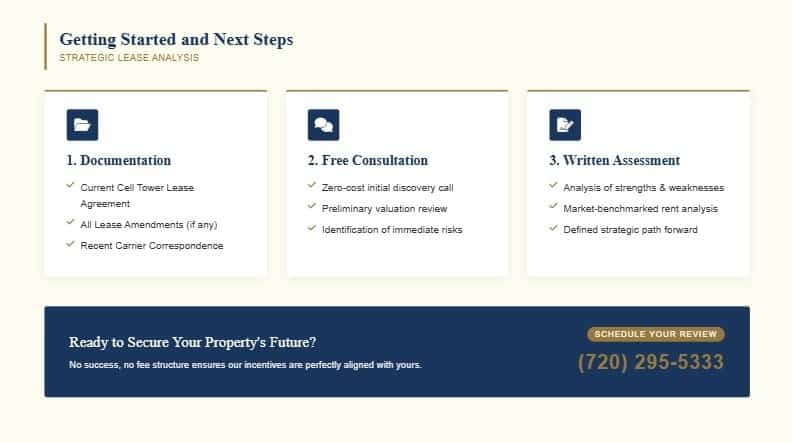
Send a copy of the lease, the most recent amendment, if any, and any correspondence you have received from the carrier or from a third-party buyout firm. The initial consultation is free. From there, you will receive a written assessment that identifies the strengths and weaknesses of your current position and recommends the specific path forward that makes the most financial sense for your situation. Call (720) 295-5333 or reach out through the contact page.
The Bottom Line: Who to Call First
If you are holding an offer letter, a lease agreement, a buyout proposal, or an amendment request, and you want the fastest way to know whether the number on the page is fair, call a cell tower lease consultant first. The initial conversation is free. If that conversation reveals that a dedicated legal engagement is needed, the consultant will tell you and coordinate with counsel. If the conversation reveals the offer is actually strong and worth signing as is, the consultant will tell you that, too.
If instead the first call you make is to a real estate attorney who has never worked on a cell tower lease before, the likely outcome is a qualified legal review that captures the legal risks and leaves the financial value largely on the table.
The hybrid option exists to remove this choice entirely. JW Tower & Telecom Consulting covers both sides of the analysis in a single engagement, with a fee structure that only pays out when your position improves. That is the right structure for a decision that locks in your property’s economics for the next 30 to 50 years.
For a free initial consultation and a written assessment of your specific situation, call (720) 295-5333 or get in touch here. Related reading: our cell tower lease consultants overview explains the full scope of services available to property owners nationwide.
About the Author
John M. Wabiszczewicz II is the founder of JW Tower & Telecom Consulting in Denver, Colorado. He holds a Juris Doctor from Roger Williams University School of Law (Bristol, Rhode Island) and a Bachelor of Science in Finance from Bentley University (Waltham, Massachusetts). John began his telecommunications career in 2007 at American Tower as an Asset Acquisitions Attorney in Greater Boston, negotiating lease extensions, capital leases, perpetual easements, and land purchases on the most strategically important cell site locations nationwide with annual spend exceeding $40 million. In 2010, he relocated to Colorado and became a Tower Acquisitions Representative for American Tower, where he acquired new cell tower assets, generating over $10 million in annual revenue. From 2013 through 2023, he led Regional Network Engineering and Real Estate for T-Mobile’s Denver Market, with operational responsibility across Colorado, Wyoming, South Dakota, Utah, Nebraska, and Kansas. He founded JW Tower & Telecom Consulting to represent property owners, drawing on the same insider knowledge he had previously applied on the carrier and tower company side. Review the firm’s BBB profile for business verification.