
Cell Tower Lease Lowball: 7 Signs Your Offer Is Below Market
The offer letter sitting on your desk was designed to look reasonable. The rent number is big enough to feel exciting. The cover letter is polite, maybe even friendly. The 30-day response window sounds like standard business practice. Every element of the packet was calibrated by someone who does this thousands of times a year to produce exactly the response they want from you.
The short answer: Cell tower lease lowball offers follow a consistent pattern that is easy to recognize once you know what to look for. The 7 signs below come from a decade spent in career-side real estate and 5 years at a major tower company. If any 3 of the 7 signs appear in your offer, you are almost certainly looking at a lowball. Call (720) 295-5333 for a free review before you respond.
Lowball offers are not accidents. They are a calibrated opening position designed to close a transaction at a price well below the market price. The carrier or tower company sending the offer has an internal valuation that is typically significantly higher than the amount they list on the cover sheet. The gap between their internal valuation and the offer they extend is the margin they expect to capture if the property owner signs without independent review.
Sign 1: The Rent Number Ends in a Round Figure
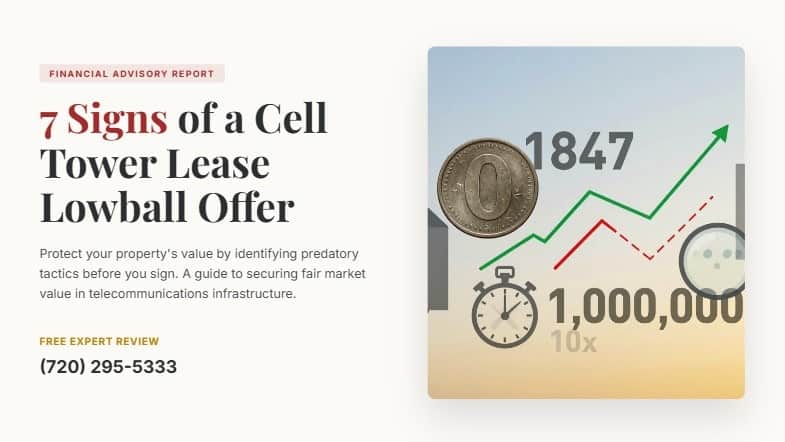
Market-rate cell tower leases are priced based on specific factors: site importance to the carrier’s network, equipment footprint, colocation potential, and local market rents. Those inputs produce specific numbers, not round ones. A fair-market lease might come in at $1,847 or $2,293 per month, depending on the actual calculation.
Lowball offers typically arrive at round numbers: $1,500, $1,800, $2,000. Round numbers are psychological anchors, not market prices. The sender chose a round number because it is easy to remember, easy to present, and easy to defend if the property owner pushes back with “can we do better?” Round numbers are a flag that the offer was constructed to feel reasonable rather than calculated from market data.
This does not mean every round-number offer is a lowball. Some carriers use round-number pricing as a starting policy. It does mean the round number deserves independent verification against comparable sites before acceptance.
Sign 2: The Escalator Is 2% or Lower
The current market for cell tower lease escalators ranges from 3% annually to CPI-linked (over the past five years, CPI-linked escalators have ranged from 3% to 9%). An offer with a 2% annual escalator is quietly locking in a below-inflation rent growth path for the life of the lease. Over a 30-year term, a 2% escalator versus a 3% escalator can result in a total rent difference exceeding $50,000 on a mid-market lease and substantially more on a higher-rent site.
Worse, some offers include no escalator at all for the first 5 or 10 years. “Flat rent” clauses are common in standard forms from certain carriers. A flat rent at 2026 market rates will feel painfully low by 2031 as inflation compounds.
Check the escalator structure carefully. If it is 2% or lower, or if there is no escalator at all during the initial term, the offer is structurally below market, regardless of the starting rent.
Sign 3: The Offer Has a 30-Day or Shorter Response Deadline
Carriers and tower companies typically do not operate on 30-day timelines internally. Their internal approval processes often take 60 to 90 days. Their capital allocation decisions happen on quarterly or annual cycles. Their network planning decisions unfold over 12 to 24 months.
A 30-day or shorter deadline on an offer letter is almost always a sales tactic, not an operational constraint. The sender knows that rushed property owners make worse decisions, skip independent review, and accept terms that a patient property owner would reject. The deadline is the mechanism for producing that rushed state.
What to do: simply do not accept the deadline. Respond politely that you are reviewing the offer with your advisors and will get back to you in due course. In almost every case, the deadline extends without issue. If the sender insists on the deadline, that insistence is itself additional evidence that the offer is not on solid market grounds.
Sign 4: The Offer Comes From a Third-Party Buyout Firm You Did Not Contact
Unsolicited offers from lease buyout firms, whether for a lump-sum buyout or for ongoing rent restructuring, are never neutral communications. The firm has identified your lease as a financially attractive acquisition target. They are not reaching out to you because they think you deserve a fair deal. They are reaching out because they have calculated that your lease is worth more than they will offer, and they are betting you will not know the gap.
This does not make the firm’s offer dishonest. A willing buyer and a willing seller can transact at any price they agree on. What it means is that the offer’s only purpose is to acquire your lease at a price that works for the buyer, and nothing in the offer letter aligns with your interest in receiving fair value.
Firms in this space include Landmark Dividend, AP Wireless, Unison, Diamond Communications, and several others. Each is a legitimate market participant. None of them is working on your behalf. If the offer arrived without your solicitation, treat it as an incoming bid in a negotiation that has not yet started, not as a conclusion you need to accept or reject.
Sign 5: The Offer Letter Does Not Include a Copy of the Actual Lease or Amendment
Serious offers come with the paperwork. The lease document, the amendment, or the purchase and sale agreement arrives with the offer letter, allowing the property owner to see exactly what they are being asked to sign. A preliminary offer that contains only a dollar figure, a term, and some friendly language, without the underlying paperwork, suggests the sender is seeking a verbal commitment before the property owner sees the actual terms.
This pattern is particularly common with third-party buyout firms. The offer letter mentions a number. The actual purchase and sale agreement, once it finally arrives after the verbal commitment, contains clauses that grant the buyer broad rights, impose tight deadlines, and limit the seller’s recourse. By the time the property owner reads the paperwork, the mental decision to accept has been made, and the paperwork’s specific language gets skimmed rather than scrutinized.
What to do: always request the complete paperwork before making any commitment. If the sender is unwilling to provide it, treat that unwillingness as additional information about the offer’s quality.
Sign 6: The Offer References “Comparable Sales in Your Area” Without Specifics
A common pitch pattern: “Our offer reflects comparable cell tower lease buyouts in your area.” No specific comparable transactions are named. No numbers are shared. No market study is attached. The phrase is a confidence-builder, not a data disclosure.
Real comparable data exists for cell tower lease transactions, but it lives in proprietary databases and private transaction records. A property owner has no practical way to verify an unspecified claim about market comparables. A cell tower lease consultant working on the property owner’s behalf can access or reconstruct comparable data; the counterparty’s “comparable sales” statement is usually a negotiating tactic rather than evidence.
What to do: if the offer references comparables, ask for specifics in writing. Get the addresses, the transaction date, and the terms. If the sender declines to provide specifics, the comparables claim is unfounded.
Sign 7: The Total Dollar Figure Feels Large Relative to Your Monthly Rent
This is the sign that trips up the most property owners. A buyout offer that represents 10 or 15 years of current rent can feel like a substantial sum, particularly to a property owner who has been collecting a few thousand dollars a month and suddenly sees a six-figure number.
The psychological anchor is wrong. A cell tower lease buyout should be valued at the net present value of future rent, typically 20 to 30 years of projected income, adjusted for the time value of money and the site’s specific risk factors. Typical buyout multiples range from 15x to 25x annual rent for fair-market transactions, depending on site quality and market conditions. An offer at 10x to 12x annual rent is materially below market, even though the absolute dollar figure looks impressive.
The test is not whether the number is big. The test is whether the number is big relative to what the lease is actually worth. An independent valuation answers that question; the emotional impact of the round figure does not.
How These Signs Combine
Lowball offers rarely exhibit just one sign. The typical pattern features multiple signs reinforcing each other: a round rent number, a 2% escalator, a 30-day deadline, an unsolicited sender, vague comparable claims, and a total dollar figure anchored to the property owner’s current monthly rent. When three or more of these signs appear together, the offer is almost certainly structured to capture margin that belongs to the property owner.
The U.S. FCC Competition and Infrastructure Policy Division publishes policy context on wireless infrastructure economics. The underlying industry economics favor well-sited towers at rates materially above what lowball offers reflect. The gap is the opportunity.
What to Do If You Are Looking at a Lowball Offer
Pause. Do not accept the deadline. Do not commit verbally. Do not sign anything. Send the offer letter and any accompanying paperwork to an independent cell tower lease consultant for a free initial review. The consultant will tell you within a week whether the offer is below market and, if so, by how much.
If the offer is fair, the consultant will tell you that too. Success-fee consultants have no incentive to manufacture work when the existing offer is actually reasonable. If the conclusion is that the offer is fair, the property owner walks away with confirmation and no invoice.
If the offer is below market, the consultant will explain the specific ways the offer is below market, the likely target for a fair-market outcome, and the engagement terms under which they would pursue that outcome on the property owner’s behalf. From there, the decision rests with the property owner.
Consider the Texas family case study. The family received an unsolicited buyout offer for a cell tower lease held by the estate. The offer exhibited multiple lowball signs: it came from a third-party firm, it had a tight deadline, and the dollar figure was calibrated to feel large relative to the family’s monthly rent. JW Tower & Telecom Consulting reviewed the offer, identified the gap to fair market value, and delivered an outcome 43% higher than the initial offer. That outcome was achievable because the initial offer was lowball by exactly the margin the firm’s review predicted.
Frequently Asked Questions
What if the offer is from my current carrier rather than a third-party buyout firm?
The same signs apply. Current carriers can and do make lowball offers, particularly on lease amendments, renewals, and buyouts. The operational playbook is similar across carriers and tower companies.
Can a cell tower lease consultant actually improve a lowball offer?
In most cases, yes. The typical outcome of a documented lowball offer is an improvement of 20% to 50% or more. Specific outcomes depend on the magnitude of the initial lowball, the carrier or buyer’s internal valuation, and the negotiation dynamics.
How long does a negotiation take to improve a lowball offer?
Typically, 30 to 90 days from engagement to final agreement. Simple cases can close in 3 to 4 weeks. Complex buyout negotiations involving title searches, surveys, and third-party lender involvement can take 3 to 6 months.
What if I already missed the 30-day deadline?
The deadline was almost certainly a tactic, not a real operational constraint. The offer is still on the table in most cases. Engaging a consultant even after the stated deadline usually produces a renewed offer with improved terms.
Does the sender know their offer is lowball?
Yes. Internal valuation models at carriers and buyout firms produce a range. The offer extended to the property owner is usually at the low end of that range, with internal authorization to go higher if the property owner pushes back with a credible counter.
What is the risk of pushing back on a lowball offer?
Minimal. In the vast majority of cases, pushing back with a credible counter produces either an improved offer or a continuation of the negotiation. The sender almost never walks away from a viable site over a counteroffer. Walking away would require them to restart the process with a different site, which is expensive and time-consuming. They prefer to come up.
Can the consultant keep the existing offer on the table while we negotiate?
In most cases, yes. The engagement letter usually preserves the existing offer as a floor while the consultant works to improve it. If the negotiation fails to produce a better result, the property owner retains the option to accept the original offer.
Is a lowball offer ever genuinely the right price?
Rarely. Genuinely fair offers do not exhibit the lowball signs listed above. If all 7 signs are absent, the offer is likely close to market. If 3 or more signs are present, the offer is lowball.
What about partial lowballs (fair rent but bad terms)?
Common pattern. The rent number looks competitive, but the escalator, assignment rights, ROFR clause, or termination language is structured to capture value back from the property owner over the term. A partial lowball is still a lowball and deserves the same review.
How do I get started?
Send the offer letter and any accompanying paperwork. The initial review is free and takes about a week. Call (720) 295-5333 or use the contact page.
Bottom Line
Lowball offers are engineered, not accidental. The 7 signs above are the fingerprints the engineer leaves on the offer letter. A property owner who can spot these signs before responding has already shifted the negotiation back toward balance. A consultant engaged to pursue a fair outcome usually delivers an improvement of 20% to 50% over the initial offer, sometimes substantially more.
For a free review of any offer you have received, call (720) 295-5333 or reach out through the contact page. The one-time cost of a review is zero. The lifetime cost of signing a lowball is measured in hundreds of thousands of dollars.
About the Author
John M. Wabiszczewicz II is the founder of JW Tower & Telecom Consulting in Denver, Colorado. He holds a Juris Doctor from Roger Williams University School of Law and a Bachelor of Science in Finance from Bentley University. He spent 5 years at American Tower and 10 years at T-Mobile, leading Regional Network Engineering and Real Estate for the Denver Market across 6 states. He founded JW Tower & Telecom Consulting to represent property owners against exactly the kind of offer tactics he previously participated in from the carrier and tower company side. Firm verification: BBB profile.