
Cell Tower Alliance Called: What They Actually Want From Property Owners
The call came in on a Tuesday afternoon. Friendly voice. Someone identified themselves as calling from Cell Tower Alliance, or Landmark Dividend, or AP Wireless, or a firm you have never heard of with “Tower” or “Wireless” somewhere in the name. They had looked at public property records. They had a preliminary buyout offer for your cell tower lease. Would you like to hear the number?
The short answer: An unsolicited call from a cell tower lease buyout firm means one thing: they have identified your lease as a financially attractive acquisition target and believe they can buy it from you at a price that works for their investors. The friendly pitch is designed to close at that price before you know what the lease is actually worth. Call (720) 295-5333 before you respond to any unsolicited buyout offer.
Unsolicited buyout calls are not randomly generated. They are the output of a deliberate prospecting process. Buyout firms run lists of cell tower leases they want to acquire, prioritized by expected return on investment. When your name comes up on that list, a specialist gets assigned to close you. Everything that happens from the first call forward is calibrated to move you from “I just learned this is possible” to “I signed the papers” as quickly as possible, at a price that captures margin for the buyer.
This is not a moral judgment on the buyout firms. They are legitimate market participants operating within legal norms. It is a description of their business model, and it should change how property owners respond to the call.
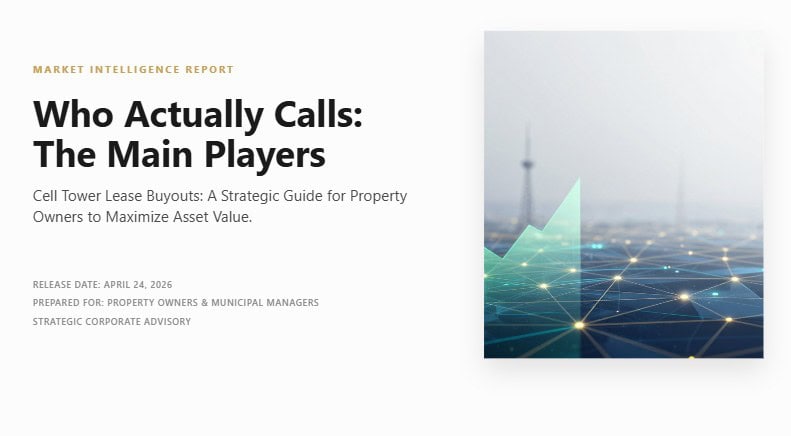
Who Actually Calls: The Main Players
The cell tower lease buyout industry is concentrated. A handful of firms account for the majority of unsolicited buyout activity in the United States. Recognizing the name on the caller ID is the first step in understanding what kind of offer is about to arrive.
Landmark Dividend is one of the largest and most active. They are backed by institutional capital and operate across wireless, energy, outdoor advertising, and other infrastructure lease types. Their pitch usually emphasizes portfolio diversification, estate simplification, and the ability to convert long-term rental income into immediate liquidity.
AP Wireless (doing business as Radius Global Infrastructure) is another major player. Focused specifically on wireless and digital infrastructure leases. Public company (NASDAQ), which means their acquisition discipline and target return requirements are disclosed in SEC filings, useful context for understanding what they are willing to pay.
Unison Site Management has historically been active in the wireless space. Private equity-backed.
Diamond Communications and similar firms focus heavily on rooftop and tower easements.
Smaller firms with rotating names: dozens of smaller buyout firms operate in this space, often under names that include “Tower,” “Wireless,” “Infrastructure,” or “Communications.” Some are well-capitalized and disciplined. Others are smaller entities that aggregate leases for resale to the larger players. “Cell Tower Alliance” is a common generic name pattern but is not a specific, well-known firm as of this writing; the phrase is sometimes used generically by various prospecting operations.
Regardless of which firm is calling, the economic logic is the same: they are buying your future rent income at a discount to its net present value. Their return comes from the gap between what they pay and what the lease is worth.
What the Opening Pitch Usually Sounds Like
The first call follows a predictable script. The caller identifies themselves and the firm, references a public record that identifies you as the property owner, and offers to share a preliminary number. They will often characterize the offer as “based on comparable transactions” or “reflecting current market conditions.” They will frame the call as an opportunity for you, not as a transaction for them.
Common framing patterns:
- “We can convert your long-term rental stream into immediate capital.”
- “This is useful for estate planning purposes.”
- “You retain ownership of the property; we just acquire the future lease payments.”
- “The market for these transactions is limited to qualified buyers like us.”
- “Our offer reflects current market comparables in your area.”
Each of these framings contains a kernel of truth and requires significant calibration. Yes, the offer converts future rent into immediate capital. Yes, it can support estate planning. Yes, you do retain the underlying property. But “the market for these transactions is limited to qualified buyers like us” is a marketing phrase, not a fact. The buyout market includes multiple well-capitalized buyers, and competitive tension among them is exactly what drives fair-market pricing. A property owner approached by a single firm can often achieve a better outcome by soliciting bids from multiple firms simultaneously.
What They Actually Want
The caller wants four things, in order.
First, they want to know whether you are the decision-maker and whether the lease is straightforward (single tenant, clean title, cooperative property owner). If the answer is no to any of these, the call ends quickly.
Second, they want to build rapport. The friendly tone is not dishonest; it is professionally cultivated. A property owner who feels a personal connection with the caller is more likely to trust the number that comes next.
Third, they want to plant a specific dollar figure in your mind before you have any independent benchmark. The sooner they anchor your thinking to their number, the easier every subsequent conversation becomes.
Fourth, they want a verbal commitment or an expression of serious interest, ideally before you have had time to consult with any independent advisor. A verbal “that sounds reasonable, send me the paperwork” is not legally binding, but it is emotionally binding. By the time the paperwork arrives, you have mentally committed, and the specific terms in the purchase and sale agreement get skimmed rather than scrutinized.
How to Respond to the Call
The right response to an unsolicited call from any cell tower lease buyout firm has three parts.
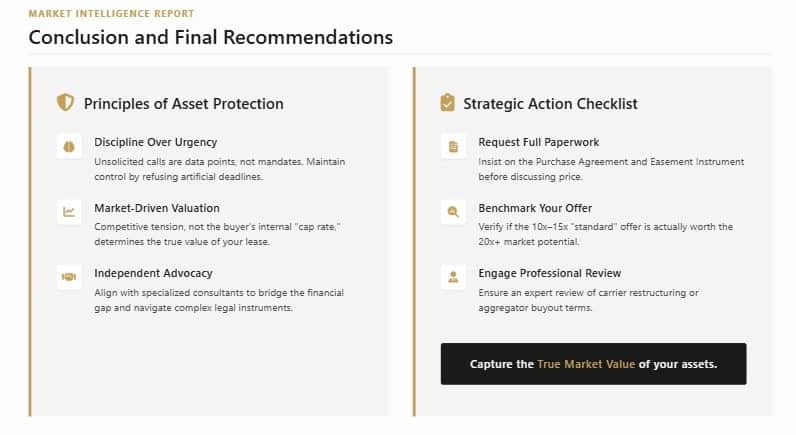
Part 1: Do not commit to anything on the call. Not a number, not a timeline, not an expression of serious interest. The polite response is: “Thank you for reaching out. I will review any offer in writing with my advisor and respond in due course.” That is it. No commitment, no anchor, no rapport-trap.
Part 2: Request the complete paperwork in writing. Ask for the offer letter, the purchase and sale agreement, and the easement instrument. Serious firms send all three. If the firm is only willing to share the headline number verbally and expects a commitment before sending paperwork, treat that as information about how they operate.
Part 3: Send the paperwork to an independent cell tower lease consultant for a free review. The review takes about a week. It produces a written assessment of whether the offer is at, above, or below market. If the offer is fair, you walk away with confirmation and no invoice. If the offer is below market, the consultant explains by how much and what the engagement would look like to pursue a better outcome.
When an Unsolicited Offer Is Actually Useful
Not every unsolicited offer is predatory. An unsolicited offer can be the starting signal for a valuable transaction, particularly if the property owner is genuinely looking to exit the lease for estate, liquidity, or tax reasons. The call is not the problem. The problem is responding to the call without independent advice.
Two scenarios where an unsolicited offer is genuinely useful:
Scenario 1: Estate liquidity. An heir managing an inherited cell tower lease often wants clean liquidation of the asset for fair distribution among beneficiaries. An unsolicited offer provides a starting bid. A consultant can then run a competitive bidding process among multiple buyout firms to reach a fair outcome. This is exactly the structure used in the Texas family case study, where the final outcome was 43% higher than the initial unsolicited offer.
Scenario 2: Material life change. A property owner facing retirement, a major medical expense, a business liquidity event, or a move may rationally prefer immediate capital over 20 years of monthly rent. If the lump-sum buyout works for the owner’s life situation, an unsolicited offer can open the negotiation. But the negotiation should still be conducted through an independent consultant to ensure the lump sum reflects fair market value rather than the caller’s initial offer.
The Numbers Behind the Pattern
Industry data suggests unsolicited buyout offers typically come in at 10x to 15x annual rent. Fair-market transactions for well-sited leases close at 18x to 25x annual rent, with premium sites sometimes exceeding 28x. The gap between the unsolicited opener and the achievable outcome is typically 30% to 60%.
On a lease paying $24,000 annually, an unsolicited offer at 12x ($288,000) versus a negotiated outcome at 20x ($480,000) represents $192,000 in value that would have been left on the table if the property owner accepted the first offer. These are not theoretical numbers. They are what the industry’s publicly traded buyers disclose in SEC filings regarding their acquisition returns.
The U.S. FCC’s Competition and Infrastructure Policy Division publishes the broader economic context shaping these transactions in the wireless industry. Reading that context confirms what the pattern of unsolicited offers implies: there is a significant spread between buyout firm acquisition prices and fair market value, and the spread is the firm’s return, not the property owner’s.
Frequently Asked Questions
Is Cell Tower Alliance a real firm?
The phrase is sometimes used generically by various prospecting operations. There are firms with names including “Alliance” or “Tower Alliance” variations. Before committing to anything, verify the firm’s legal name, state of incorporation, SEC filings if public, and track record. Reputable firms welcome this diligence. Opaque firms resist it.
Should I ever take the first unsolicited offer?
Almost never. The first offer is by design a starting position, not a final offer. Even reputable firms open at a number they are prepared to improve if the property owner pushes back through an independent advisor.
Can I get competing offers from multiple buyout firms?
Yes. A cell tower lease consultant can structure a competitive bid process among qualified buyers. Competitive tension typically leads to better pricing and terms. This is often the fastest way to a fair outcome.
What if the caller pressures me for a decision?
Pressure tactics are a flag. A legitimate fair-market transaction does not require pressure. If the caller insists on an immediate decision, that insistence is additional information about whether the offer reflects fair value.
Is it rude to decline to engage on the call?
No. The polite response is to thank the caller for reaching out and to decline to discuss specifics until you have the paperwork in hand and the advisor’s review completed. Professional callers expect this response and proceed accordingly. Amateurish callers push back, which tells you something useful.
Can the caller find out how much my current lease pays?
Often, yes, through public records or industry databases. The county recorded memorandums, certain carrier disclosures, and some state public utility commission filings contain lease information. The caller knowing your rent is not by itself evidence of anything improper. It is simply how the prospecting process works.
What if I already said yes on the call?
A verbal statement is not legally binding. You have not committed until you have signed the purchase and sale agreement. Pull back politely, explain you are reviewing with advisors, and take the time you need.
What happens if I ignore the call?
Usually nothing. The caller moves to the next name on the list. Some firms will follow up with a letter. Others will re-attempt contact in a few months. Ignoring the call carries no downside.
Can my cell tower lease consultant negotiate the buyout for me?
Yes. This is the core engagement for buyout transactions. JW Tower & Telecom Consulting engages in success fees, typically a percentage of the transaction value, paid only at closing. The firm negotiates directly with the buyout firm on the property owner’s behalf, with the property owner retaining final decision-making authority.
How do I get started?
Send the offer letter, the firm’s name, and any paperwork they have provided. The initial review is free. Call (720) 295-5333 or use the contact page.
What to Look For in the Paperwork That Follows the Call
When paperwork arrives from the caller, specific sections warrant careful review before responding.
In the purchase price section, is the number stated clearly, with no contingencies that could reduce it later? Some aggressive buyout structures include deductions for surveys, legal costs, or title issues that were not mentioned on the call.
The representations and warranties: what is the property owner being asked to warrant? Broad warranties regarding lease compliance, tenant payment history, and third-party claims can expose the owner to future clawback claims if any representation proves incorrect.
The indemnification provisions: what ongoing liability does the owner retain after closing? Clean transactions release the owner from all future obligations. Less-clean transactions retain the owner’s liability for certain categories of claims.
The recording instructions: what documents will be recorded in the county land records? The property owner retains title to the real property but grants an easement or assigns the lease to the buyer. The recorded documents should accurately reflect what was agreed.
The timeline: are there time-pressured deadlines embedded in the paperwork? Standard transactions close in 60 to 90 days. Paperwork demanding 14-day closings with liquidated damages for delay is aggressive and should be negotiated.
When the Unsolicited Call Is From Your Own Carrier
Occasionally, the unsolicited contact comes not from a third-party buyout firm but from the carrier or tower company that holds the lease itself. This is a different scenario with different dynamics.
Carriers and tower companies sometimes approach property owners with offers to restructure the existing lease: longer term in exchange for a rent reduction, a lump sum in exchange for removal of certain landowner protections, or a bundled amendment that consolidates multiple past issues. These offers are legitimate but still deserve independent review.
The advantage of a carrier-initiated restructuring is that the counterparty is known and the relationship is ongoing. The disadvantage is that the carrier’s internal team has modeled the restructuring to improve their own position, which typically means the property owner’s position will be modestly worse unless specific terms are improved. A consultant engaged in a carrier restructuring negotiation typically improves 3 to 5 specific terms even when the rent number is fixed.
Bottom Line
An unsolicited call from a cell tower lease buyout firm is not a problem. It is a data point. It tells you that your lease is financially attractive to a well-capitalized buyer. The right response is to collect the paperwork, decline to commit, and send the offer through independent review. The review is free at success-fee firms. The decision remains with you. The outcome, if you choose to transact, should reflect fair market value rather than the caller’s opening anchor.
If a call has come in and you want an independent read on the offer before responding, call (720) 295-5333 or reach out through the contact page.
About the Author
John M. Wabiszczewicz II is the founder of JW Tower & Telecom Consulting in Denver, Colorado. He holds a Juris Doctor from Roger Williams University School of Law and a Bachelor of Science in Finance from Bentley University. He spent 5 years at American Tower and 10 years at T-Mobile, leading Regional Network Engineering and Real Estate for the Denver Market. He founded JW Tower & Telecom Consulting to represent property owners against exactly the kind of prospecting and pricing tactics he observed from the tower company side of the industry. Firm verification: BBB profile.