
Cell Tower Lease Consultant: 10 Questions to Ask First
If you have an offer letter on your desk from a wireless carrier or a lease buyout firm, you have probably already received at least one cold call from a self-described “cell tower lease consultant” who saw your name in a county property record and decided you were their next client. The pitch is always confident. The credentials are usually vague. And the urgency is almost always manufactured.
The short answer: Most property owners hire a cell tower lease consultant once in their lives. Carriers and tower companies hire hundreds of specialists every year. You cannot afford to pick the wrong side of that asymmetry. The 10 questions below separate consultants with real carrier-side operating experience from firms whose entire claim to authority is a phone number and a website. Before you hand over a copy of your lease to anyone, you should be able to write down the answers to all 10.
Here is the uncomfortable truth about this industry. The term “cell tower lease consultant” is unregulated. No license. No exam. No continuing education. Anyone can print a business card and call themselves one. This is not a criticism of the firms that operate this way. It is a statement of fact that should change how a property owner does due diligence before signing a consulting agreement that may affect the economics of their property for the next 30 to 50 years.
You negotiate one cell tower lease in your life. Your consultant should have negotiated thousands. The 10 questions below help you figure out whether they actually have.
Question 1: “Where Did You Actually Work Inside the Industry, and in What Role?”
Every consultant will claim “industry experience.” That phrase hides a huge range of actual backgrounds. The difference between someone who spent three years as a junior site acquisition agent and someone who led regional real estate and construction for a top-three wireless carrier is the difference between a student driver and a commercial pilot. Both are technically “in the industry.” Only one person can actually fly the plane.
What you want to hear: specific company names, specific job titles, and specific date ranges. “I worked at American Tower from 2007 to 2013, first as an Asset Acquisitions Attorney and then as a Tower Acquisitions Representative, and from 2013 to 2023, I led Regional Network Engineering and Real Estate at T-Mobile for the Denver Market.” That is a specific, verifiable, operational answer.
What should concern you: phrases like “two decades in wireless,” “industry veterans,” “experience with all the major carriers.” These are marketing strings, not verifiable resumes.
Question 2: “Have You Ever Been the Person Who Wrote the Letter I Am Holding?”
A property owner receiving a lease offer, an amendment request, or a buyout proposal is holding a document that somebody inside the carrier or tower company drafted, approved, and sent. The most valuable consultant is the one who has been on the other side of that exact workflow.
What you want to hear: yes, and here is how the approval chain worked. A consultant who has actually drafted and approved these letters from the carrier side can tell you which clauses are negotiable inside the carrier’s internal approval process, which clauses will never move because they are tied to risk policy, and how much lead time the carrier’s lawyers need to process a counterproposal. This is practitioner-level knowledge.
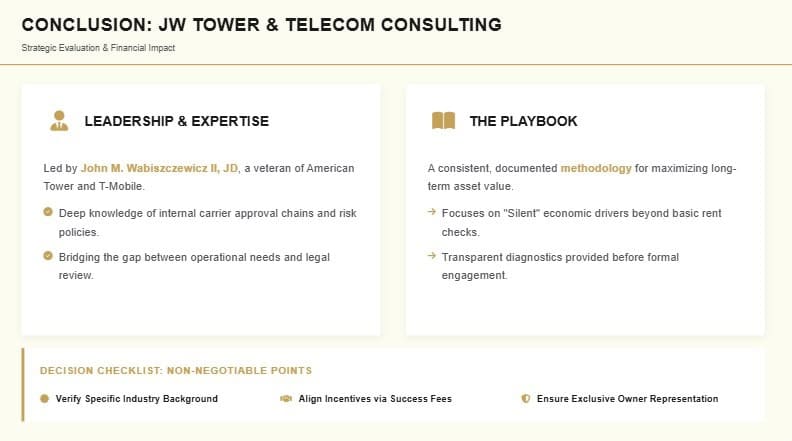
At JW Tower & Telecom Consulting, the answer is yes. Founder John M. Wabiszczewicz II spent five years at American Tower as an Asset Acquisitions Attorney and Tower Acquisitions Representative, with transactions across the United States and an annual spend exceeding $40 million. He has personally drafted language that is substantially similar to what now appears on property owners’ desks.
Question 3: “How Are Your Fees Structured?”
The answer to this question tells you everything about what the consultant actually believes about the engagement.
A consultant charging a flat retainer collects their fee whether or not your position improves. Their financial outcome is independent of yours. If they spend two hours on your file and the offer you already have is genuinely fair, they still bill you. If they spend two hours and the offer you already have is deeply unfair and they identify $200,000 in value on the table, they still bill you the same amount. The incentive structure rewards billing hours, not outcomes.
A consultant who charges by the hour is in a similar position. More hours equals more money. You are paying for their time.
A consultant operating on success fees only gets paid if your position improves. If the offer you have is already fair, you pay nothing. If the offer is undervalued and they deliver a better outcome, their fee is a percentage of the incremental value. This structure aligns their incentive with yours and eliminates the risk that you spend money on professional fees only to learn that nothing needs to change. JW Tower & Telecom Consulting uses this structure.
Ask how the fee is structured. Then ask what happens if the current offer turns out to be fair.
Question 4: “Do You Represent Property Owners Only, or Also Carriers and Tower Companies?”
This is the conflict-of-interest question, and it matters more than most property owners realize. A consultant who has active client relationships with wireless carriers or tower development firms has a structural incentive to preserve those relationships. That may mean softening negotiation positions, declining to raise issues that would anger the carrier, or simply not taking cases that would put them on the other side of a major client.
What you want to hear: We represent property owners exclusively. No carrier work. No tower company work. No lease buyout firm work.
What should concern you: any answer that includes “we work with everyone in the industry” or “we have relationships on all sides.” Those are positioning statements that often mask a conflict. A lawyer representing you against a company he also represents for other work is in an impossible position. A consultant is no different.
Question 5: “What Is the Specific Market Rate for a Lease Like Mine, and How Do You Know?”
This question reveals whether the consultant has access to current, localized market data or is guessing based on publicly available information.
What you want to hear: a specific number with a specific source. “Based on the comparable leases I have worked on or reviewed in Jefferson County over the past 24 months for sites of this size and carrier mix, market rate is between $2,200 and $2,800 per month with annual escalators of 3% or better. I know this because I have personally negotiated X leases in this county over that period.” That is a data-backed, defensible answer.
What should concern you: vague ranges, refusal to commit to a specific number, or claims that market data is “proprietary” and cannot be shared until after you sign an engagement. Real market data comes from real recent transactions. If the consultant has actually closed comparable deals in your market, they should be able to give you a defensible range in the initial conversation.
Question 6: “What Clauses Are You Going to Focus On, and Which Ones Are Most Expensive Silently?”
Most property owners fixate on the rent number because it is the most visible line on the page. A skilled consultant knows that the rent figure is usually the third- or fourth-most important economic variable in a cell tower lease. The clauses that silently cost the most money are the ones that never appear on the cover sheet.
What you want to hear: a specific list of 4 to 6 clauses that the consultant will examine carefully and explain the economic impact of. At a minimum, the list should include the escalator structure, assignment rights, any Right of First Refusal clause, the termination provisions, the renewal option structure, and the definition of the equipment area.
What should concern you: a consultant who talks only about rent. Rent is the bait. The real value lies in the terms. For a deeper explanation of this dynamic, see the JW Tower blog post on why lease terms matter more than rent.
Question 7: “What Is Your Track Record, and Can You Share a Case Study With Specific Numbers?”
Vague claims about helping “hundreds of property owners” do not belong in a professional services conversation. A consultant worth hiring should have at least two or three case studies they can walk you through, each with specific numeric outcomes: how much the original offer was, what the final outcome was, and what the delta represented in absolute and percentage terms.
What you want to hear: a Texas family case study where the initial buyout offer was X, the negotiated outcome was 43% higher than X, the estate was liquidated cleanly, and the value was distributed to the heirs. A Kentucky property owner case where the unsolicited buyout offer was restructured into a substantially higher lump sum. A Texas self-storage operator, where the initial terms were identified as undervalued, and the final agreement reflected the property’s actual infrastructure importance.
What should concern you: case studies without numbers, testimonials without names, or “we have a long track record” statements unsupported by specifics. The industry’s most reputable firms publish their outcomes. If they cannot or will not, ask why.
Question 8: “If I Decide Not to Hire You, Will I Still Understand What You Found?”
This question tests whether the consultant treats the initial consultation as a genuine diagnostic or as a sales funnel. A firm that believes in its value proposition has no reason to hide findings from a prospect. A firm that believes its only product is the retainer you are about to sign has every reason to withhold anything useful until you commit.
What you want to hear: yes, the initial consultation produces a written assessment that identifies the strengths and weaknesses of your current position, whether or not you engage us for the negotiation. If we believe the offer is fair as-is, we will tell you, and you will walk away with that knowledge and no invoice. If we believe there is value to negotiate, we will explain what we would do and what it would cost under our fee structure. Your decision from there.
What should concern you: a consultant who treats specific findings as proprietary until you sign an engagement. That is a sales tactic, not a professional practice.
Question 9: “If I Have an Attorney I Already Trust, How Do You Work With Them?”
Many property owners have a real estate attorney, a business attorney, or a family attorney they have worked with for years. A consultant who tries to push that attorney out of the transaction is solving for their own billing, not for your outcome.
What you want to hear: enthusiastic willingness to coordinate with your existing counsel. A specific description of the division of labor: the consultant covers the wireless industry operational expertise and market valuation, and the attorney covers the legal review under the relationship of trust that already exists. This is the cleanest model for most property owners.
What should concern you: a consultant who waves off your existing attorney as “not specialized enough for this” without offering to work alongside them. The absence of a credible attorney relationship is not a credential. It is a flag.
Question 10: “Are You Named on the Firm’s Engagement, or Will I Be Passed to Someone Else After I Sign?”
This is the bait-and-switch question. Some firms advertise a senior principal with a strong resume, close the engagement on that strength, then hand the actual file to a junior associate or a subcontractor. By the time the property owner realizes the person doing the work is not the person they were sold to, the engagement is months along, and switching is expensive.
What you want to hear: the principal’s name on the engagement letter, with a specific description of who is doing what. For a small specialist firm, this answer is simple: the principal handles the file personally. For a larger firm, the answer should include the team composition and identify the property owner’s main point of contact.
What should concern you: evasive answers, or an engagement letter that grants the firm unilateral rights to substitute personnel without notice.
Bonus Question: “What Happens if We Disagree?”
Consultants, like any professional, sometimes recommend a course of action the client disagrees with. A well-run engagement has a clear process for resolving those disagreements without derailing the transaction. The client makes the final decision on any offer. The consultant provides the analysis and the recommendation. If the client decides to accept terms the consultant recommended against, the consultant documents the recommendation and respects the decision.
What should concern you: firms that become combative when clients push back, or firms whose engagement letters lock the client into accepting the consultant’s recommendations as a condition of the fee structure. You are the property owner. You sign the lease. You make the final call.
How to Use These 10 Questions
The purpose of these questions is not to interrogate a professional. It is to test the quality of the fit. A qualified consultant will recognize these questions as the right ones and will answer each one directly, with specifics, without getting defensive. An unqualified consultant will get annoyed or hedge.
The fastest way to run this diagnostic is to email all 10 questions to every consultant you are considering and ask for written answers. Written responses force clarity. You can compare answers side by side. The consultant who writes tight, specific answers to every question has likely been through this exercise before and is not afraid of the diagnostic. The consultant who writes vague marketing responses or avoids questions has told you what you need to know.
For an illustration of how JW Tower & Telecom Consulting would answer each of these questions, read the firm’s leadership team page and the full case study library on the site. The FCC Wireless Telecommunications Bureau maintains public information on wireless industry structure that can help property owners understand the operational environment these consultants claim to know.
Frequently Asked Questions
How many cell tower lease consultants should I interview before choosing one?
Two or three is usually enough to see a clear difference in quality. Beyond three, diminishing returns set in, and you risk decision paralysis. Send the 10 questions above in writing and compare responses. One consultant will stand out, and often the differences between a strong answer and a vague one are obvious within the first 3 questions.
Are there licensing requirements for cell tower lease consultants?
No. The profession is unregulated at the federal and state levels. Some practitioners hold related credentials such as a Juris Doctor, a real estate license, or a surveyor’s license. These are not required. The absence of a licensing regime is exactly why the 10 questions above matter.
Can I verify a consultant’s carrier-side or tower-company experience?
Yes, and you should. LinkedIn profiles are the easiest verification tool. Any consultant claiming specific employment with American Tower, SBA Communications, Crown Castle, T-Mobile, AT&T, Verizon, or similar should list that employment on their LinkedIn profile, with dates that match those on their resume. Cross-reference what they tell you against their public professional record.
What does a fair fee structure look like for a cell tower lease buyout engagement?
The industry norm for success-fee consultants on lease buyouts is a percentage of the transaction value, typically 5% to 15%, depending on deal complexity and size. For lease negotiations on rent and terms, the success fee is typically tied to the incremental new revenue secured over a defined measurement period. Flat-fee arrangements exist but are less common and tend to misalign incentives. If a consultant’s fee structure does not scale with outcome, ask why.
Should I sign a non-disclosure agreement before the initial consultation?
No. A reputable consultant should be willing to provide an initial assessment in accordance with standard professional confidentiality practices that already apply to client files. An NDA that the consultant asks you to sign before they will tell you anything substantive is a flag. Reverse the situation: you may want the consultant to sign an NDA protecting your lease data, which is reasonable and common.
What should I bring to the initial consultation?
Bring a copy of your current lease, any amendments that have been executed over the years, any recent correspondence from the carrier or tower company, and any offer letter or buyout proposal you have received. If you do not have all the documents immediately at hand, that is fine. A competent consultant will guide you through gathering the rest.
How long should the initial consultation take?
Typically, 30 to 60 minutes. Long enough to review your documents and identify the key issues. Short enough that the consultant respects your time and demonstrates they can operate efficiently. If the consultant is using the initial consultation as a two-hour sales pitch, that is information about how they will handle your engagement.
Can I hire both a consultant and an attorney?
Yes, and for larger transactions, this is often the right model. See our full breakdown of when each professional is needed in our post on the cell tower lease consultants service overview. The practical coordination is straightforward when both professionals are experienced and communicate clearly.
What happens if the consultant’s recommendation conflicts with my attorney’s recommendation?
The property owner makes the final call. Both professionals should be willing to explain their reasoning in writing, and the owner should have the final decision rights in the engagement letter with each. Conflicts usually resolve quickly when both sides articulate their concerns clearly. When they do not resolve, the property owner has the information needed to make an informed choice.
How do I get started with JW Tower & Telecom Consulting?
Send a copy of your current lease, any amendments, and any recent correspondence or offer letters. The initial consultation is free and produces a written assessment. Call (720) 295-5333 or use the contact page to get started.
Bottom Line
The cell tower lease consulting industry is small, specialized, and lightly regulated. Most property owners find a consultant through a cold call, a web search, or a recommendation from someone who has had exactly one cell tower lease in their life. That is a thin basis for a decision that affects your property for decades.
The 10 questions in this post are the diagnostic a property owner uses to cut through the noise. They identify the consultants who actually have carrier-side or tower-company-side operational experience, a track record with specific numbers, a fee structure aligned with outcome, and a willingness to work alongside your existing attorney. They filter out the ones who cannot substantiate their claims.
JW Tower & Telecom Consulting was built to answer each of these questions clearly. Founder John M. Wabiszczewicz II holds a Juris Doctor, spent 5 years at American Tower and 10 years at T-Mobile, represents property owners exclusively, operates on a success-fee structure, and will coordinate cleanly with your existing attorney. The Cell Phone Tower Playbook methodology is consistent, documented, and repeatable.
For a free initial assessment, call (720) 295-5333 or reach out through the contact page.
About the Author
John M. Wabiszczewicz II is the founder of JW Tower & Telecom Consulting in Denver, Colorado. He holds a Juris Doctor from Roger Williams University School of Law (Bristol, Rhode Island) and a Bachelor of Science in Finance from Bentley University (Waltham, Massachusetts). John began his telecommunications career in 2007 at American Tower as an Asset Acquisitions Attorney in Greater Boston, negotiating lease extensions, perpetual easements, and land purchases on the most strategically important cell site locations nationwide with annual spend exceeding $40 million. In 2010, he relocated to Colorado and became a Tower Acquisitions Representative for American Tower. From 2013 through 2023, he led Regional Network Engineering and Real Estate for T-Mobile’s Denver Market, with operational responsibility across Colorado, Wyoming, South Dakota, Utah, Nebraska, and Kansas. He founded JW Tower & Telecom Consulting to represent property owners, drawing on the same insider knowledge he had previously applied on the carrier and tower company side. Firm verification: BBB profile.