
Cell Tower Lease Consultant vs Real Estate Agent vs Buyout Firm: Who Does What
A property owner who receives a cell tower lease offer, an amendment request, or a buyout proposal usually has a short list of professionals they already know: a cell tower lease consultant, a real estate agent, or a buyout firm. The real estate agent who sold them the property. The attorney who handled the closing. And now, increasingly, the cold-calling “lease acquisition specialist” who appeared out of nowhere, offering to buy out their cell tower lease for a lump sum.
The short answer: A real estate agent sells properties. A cell tower lease consultant reads cell tower leases for value. A lease buyout firm is the counterparty trying to buy your future income for less than it is worth. These three roles are not interchangeable, and confusing them is the single most expensive mistake a property owner makes in this niche. Call (720) 295-5333 to understand which of the three you actually need.
Each of these three roles has a different financial interest in your cell tower lease. Understanding that interest is the single most important step in choosing the right professional for your situation.
What a Real Estate Agent Does With Your Cell Tower Lease
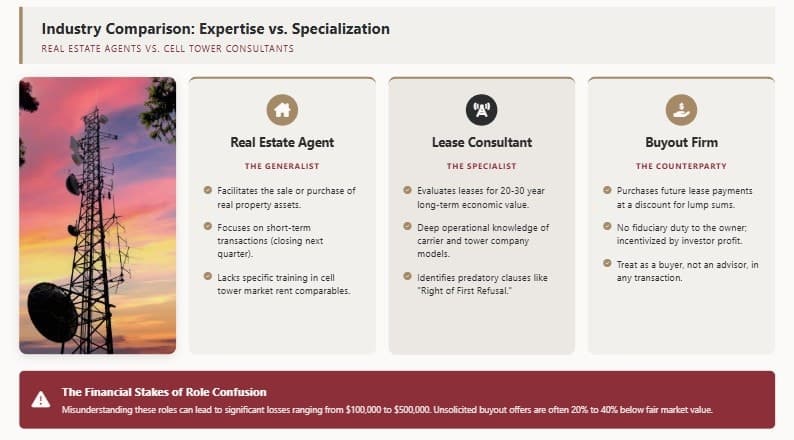
A real estate agent is licensed by a state real estate commission and regulated by that commission’s rules of practice. An agent is trained and compensated to facilitate the sale or purchase of real property. That is their core competency, and it is a valuable one when the transaction is a property sale.
A cell tower lease is not a property sale. It is a long-term encumbrance on the property, typically 30 to 50 years with automatic renewals. Most state real estate licensing regimes do not require specific training in cell tower lease negotiation, and the continuing education curriculum agents complete annually rarely addresses the wireless industry in any depth. An agent can give you an opinion on whether a cell tower lease will increase or decrease your property’s resale value. That is useful input. What an agent generally cannot do is tell you whether the monthly rent number is fair, whether the Right of First Refusal clause is standard or predatory, or whether the escalator structure keeps pace with inflation over 30 years.
Real estate agents are also compensated on transaction commissions. If they are helping you think through the cell tower lease as part of a larger sale of the property, they have a financial interest in the property’s sale. That is not a conflict of interest in the formal sense; it is a misalignment of focus. The question you are asking is “Is this lease fair for the next 30 years?” and the professional you are asking is paid to close a transaction next quarter.
The right use of a real estate agent on a cell tower lease question is narrow: ask them about local property market trends, comparable sales that include cell tower leases as an encumbrance, and any local zoning or permitting dynamics they have observed in the neighborhood. Treat their input as a single data point, not the primary review.
What a Cell Tower Lease Consultant Does With Your Lease
A cell tower lease consultant is not regulated by a licensing regime. The absence of a regulatory body cuts both ways: there is no mandatory training and no barrier to entry, which means the quality of consultants in this niche varies enormously. A skilled cell tower lease consultant has spent years in the industry, typically at a wireless carrier, a tower company, or a real estate and construction team that executed on behalf of those entities.
The consultant’s job is to read the cell tower lease for value. They evaluate the rent against current market rates in the specific county and metro. They model the escalator structure against likely inflation and market drift. They identify clauses that silently reduce the lease’s economic value, including Right of First Refusal provisions, broad assignment rights, and indefinite renewal language. They coordinate with the carrier or tower company on amendment and renewal negotiations. And when the question is whether to accept or reject a buyout offer, they provide an independent valuation against comparable buyout transactions and recommend specific counter-terms.
JW Tower & Telecom Consulting operates on a success-fee structure. The consultant is paid only when the client’s position improves. Founder John M. Wabiszczewicz II brings 15 years of direct industry experience to every engagement: 5 years at American Tower as an Asset Acquisitions Attorney and Tower Acquisitions Representative, then 10 years at T-Mobile leading Regional Network Engineering and Real Estate across six Rocky Mountain states. He also holds a Juris Doctor from Roger Williams School of Law and a Bachelor of Science in Finance from Bentley University.
That dual-sided background means the consultant has literally sat in the chair on the other end of the letter you are holding. He has drafted the language the carrier uses to describe equipment areas. He has priced the carrier’s perpetual easement offers. He has decided, as a regional leader, which sites to prioritize for retention and which amendment requests to advance at landowner expense. When he now reviews a lease on behalf of a property owner, he is reading a document he helped write earlier in his career.
What a Lease Buyout Firm Actually Is
This is the role most property owners mistake for “cell tower lease consultant,” and that confusion is costly. A lease buyout firm is a counterparty, not a professional advisor. They are in the business of acquiring future lease payments at a discount. They make their money by offering property owners a lump sum that is less than the net present value of the future payments they will then collect.
Well-known firms in this space include Landmark Dividend, AP Wireless, Unison, Diamond Communications, and several others. Each of these firms has a business model that is legitimate in its context. They buy from willing sellers. They close transactions efficiently. They are genuine market participants.
What they are not is your advisor. A lease buyout firm calling to offer you a buyout has no fiduciary duty to you, no obligation to tell you if the offer is below market, and no incentive to recommend you seek independent representation. Their sales pitch is designed to close a transaction at the price point that works for their investors. That is the business they are in.
The common scenario: a property owner receives an unsolicited phone call or letter from a lease buyout firm offering a lump sum for their cell tower lease. The number sounds large. The deadline sounds urgent. The friendly voice on the phone frames the deal as an obvious win. Without independent advice, the property owner signs, and the buyout firm collects 20 to 40 years of future income at a price that typically reflects a significant discount to fair market value.
When a buyout offer arrives, the right move is almost always to pause, decline to commit to any deadline, and bring in an independent cell tower lease consultant to evaluate the offer before responding. A consultant working on success fees has no reason to tell you the offer is unfair if it is actually fair. They have every reason to find the opportunities to improve it if it is not.
The Side-By-Side Breakdown
Here is the practical division of responsibilities when a property owner is working through a cell tower lease question.
Who Evaluates Market Rent
The cell tower lease consultant. Real estate agents do not have access to cell tower lease comparables. Lease buyout firms have the data, but are not aligned with your interests in using it.
Who Reads the Legal Clauses
A real estate attorney should review the legal mechanics (indemnification, default, governing law). A cell tower lease consultant should read the economically significant clauses (escalators, Right of First Refusal, assignment, termination rights). If the consultant is also a Juris Doctor, as at JW Tower & Telecom Consulting, both functions can happen in a single engagement.
Who Evaluates Buyout Offers
A cell tower lease consultant with access to comparable buyout transactions. The lease buyout firm making the offer cannot credibly fill this role because they are the counterparty. A real estate agent cannot fill this role because they lack the underlying data.
Who Negotiates Amendments
A cell tower lease consultant, working directly with the carrier or tower company. This is an industry-specific negotiation that requires operational knowledge of the carrier’s internal approval process. A real estate agent cannot add value here. A lease buyout firm will not be involved unless the amendment is tied to a buyout transaction.
Who Handles the Sale of the Property
A real estate agent, with the consultant available to explain to prospective buyers how the cell tower lease affects the property’s long-term value. This is the scenario where all three roles can work together cleanly, each in its own lane.
When the Roles Overlap and How to Handle It
Two scenarios overlap, tripping up property owners.
Scenario 1: You are selling the property, and the cell tower lease is part of the asset. The real estate agent needs to explain the lease to prospective buyers. The cell tower lease consultant should produce a one-page summary of the lease’s economic value that the agent can share with qualified buyers under NDA. This increases the property’s perceived value by making the lease transparent and defensible. It also prevents the agent from accidentally misrepresenting the lease terms.
Scenario 2: You inherited the lease, and the estate needs to liquidate the asset. The executor or trustee often needs a clean exit from the lease, which means either selling the lease to a buyout firm or selling the property outright. Here, the consultant’s independent valuation is essential to ensure the estate does not accept a lowball buyout from a firm that called the executor first. Once the valuation is established, the estate can solicit competing bids from multiple buyout firms or structure a sale of the property that captures the lease’s full value.
The Financial Stakes of Picking Wrong
The cost of choosing the wrong professional is not trivial. A typical cell tower lease has a lifetime value in the mid-six- to low-seven figures. A 20% to 40% valuation gap between a lowball buyout offer and the fair market value is common. The difference between accepting the first offer that arrives and running the offer through an independent consultant can easily be $100,000 to $500,000 on a single transaction.
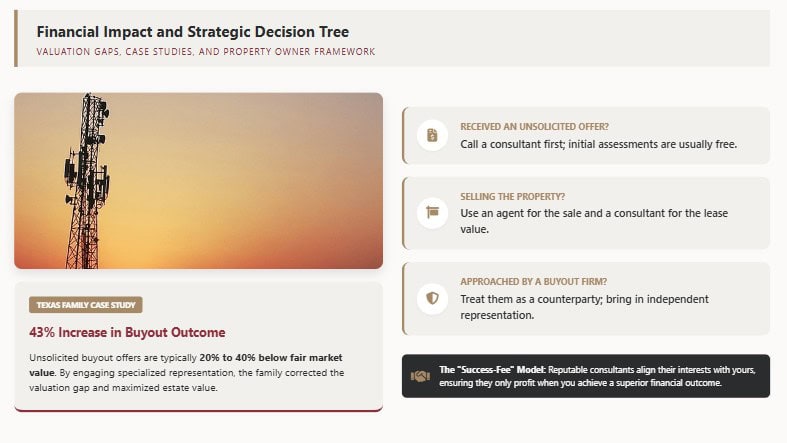
Consider the pattern documented in the JW Tower Texas family case study. A Texas family administering an estate received an unsolicited buyout offer. Without an independent review, the estate would have accepted the offer and moved on. With the consultant engaged, the final outcome was 43% higher than the initial offer. On a seven-figure transaction, that is a six-figure swing in favor of the heirs.
The U.S. Federal Communications Commission’s Competition and Infrastructure Policy Division publishes national-level policy context that shapes how wireless infrastructure is valued over time. Industry-specific professionals track this policy environment; real estate agents and lease buyout firms generally do not factor it into conversations with property owners. This is one of many reasons the professional who belongs in the room when lease economics are being evaluated is the specialist, not the generalist.
The Practical Decision Tree
Here is how to route your situation to the right professional.
If you received a lease offer, an amendment request, or a buyout proposal, call a cell tower lease consultant first. The initial consultation is free at firms that operate on a success-fee basis. The consultant will tell you whether the offer is fair, whether there is value to negotiate, and whether you should bring in an attorney. If the answer is that the offer is fair, you walk away with that confirmation and no invoice. If there is value to negotiate, the consultant explains what the engagement entails and on what terms.
If you are preparing to sell the property and the cell tower lease is an encumbrance, engage your real estate agent and a cell tower lease consultant in parallel. The agent handles the property marketing. The consultant produces the lease summary that supports the property’s valuation.
If a lease buyout firm has called you, do not engage them as your advisor. Engage a cell tower lease consultant as your advisor. Let the buyout firm present its offer, then have the consultant evaluate it independently. If the offer is fair, you can accept it with confidence. If it is not, the consultant can help you negotiate improved terms or solicit competing bids.
If you already have a real estate attorney you trust, and you want legal review of the cell tower lease, engage the attorney for legal review and a cell tower lease consultant for value review. The two professionals work in parallel.
Frequently Asked Questions
Is a real estate agent ever the right primary professional for a cell tower lease question?
Only when the cell tower lease is incidental to a property sale. For any question focused on the lease itself (rent, terms, amendments, buyouts), a cell tower lease consultant is the appropriate primary professional.
Can a real estate attorney substitute for a cell tower lease consultant?
A real estate attorney covers the legal mechanics. A cell tower lease consultant covers the industry-specific value analysis. Most real estate attorneys do not have access to cell tower lease comparables and have not worked inside wireless carriers or tower companies. For a detailed breakdown, see our post on cell tower lease consultant vs real estate attorney.
Are lease buyout firms dishonest?
Not necessarily. Most are legitimate market participants operating within legal and ethical norms. They are counterparties to the transaction, not advisors. That distinction is critical. An honest counterparty is still a counterparty. Your advisor should be someone with no financial interest in the outcome of the transaction.
How do I tell a real cell tower lease consultant from a lease buyout firm in disguise?
Ask directly: Do you represent property owners only, or do you also buy their leases? A firm that answers “we buy leases” is a counterparty. A firm that answers, “We represent property owners exclusively and earn our fee only when your position improves,” is a consultant.
What is the typical timeline to evaluate a buyout offer?
A cell tower lease consultant can typically produce an initial assessment within a week of receiving the lease and the offer. Final negotiation of a counteroffer or a competing bid process usually takes 30 to 90 days. The drop-dead deadlines that buyout firms put on their offers are almost always negotiation tactics, not real deadlines.
Can I use all three professionals on a complex transaction?
Yes. On a large transaction or an estate situation, the full team is the real estate agent (if a property sale is involved), the real estate attorney or estate attorney (for the legal mechanics), and the cell tower lease consultant (for the lease value analysis). Each professional stays in their lane, and the property owner gets complete coverage.
Why would a lease buyout firm offer me less than the lease is worth?
Because that is how the business model works. A lease buyout firm earns its return by buying at a discount to net present value. They are not being dishonest by offering a discounted price; they are doing what buyers do. The property owner’s defense is based on independent valuation and competitive tension among multiple buyers.
Does a real estate agent’s commission come out of my cell tower lease income?
Not typically. Real estate agent commissions are tied to property sales, not lease income. If you are selling the property, the agent is compensated on the property sale price. The cell tower lease is part of what makes the property more or less valuable, but the lease itself is not a commissionable transaction for the agent.
Can the same firm represent me as both consultant and attorney?
Yes, when the consultant also holds a Juris Doctor. JW Tower & Telecom Consulting operates this way. The founder’s JD allows the firm to handle the legal review of the lease alongside the industry-specific value analysis, all under a single engagement and a single success-fee structure. For transactions requiring licensed legal representation in a specific state, the firm coordinates with local counsel.
How do I get started?
Send a copy of your lease, any amendments, and any offers or correspondence you have received. The initial consultation is free. Call (720) 295-5333 or use the contact page.
Bottom Line
The three roles are not interchangeable. A real estate agent sells properties. A cell tower lease consultant reads cell tower leases for value. A lease buyout firm is the counterparty trying to buy your future income. Each has a legitimate place in the ecosystem. The property owner’s job is to route the right question to the right professional and to remember which of the three is on their side of the table.
For a free initial consultation, call (720) 295-5333 or reach out through the contact page.
About the Author
John M. Wabiszczewicz II is the founder of JW Tower & Telecom Consulting in Denver, Colorado. He holds a Juris Doctor from Roger Williams University School of Law and a Bachelor of Science in Finance from Bentley University. John began his telecommunications career in 2007 at American Tower as an Asset Acquisitions Attorney in Greater Boston. In 2010, he became a Tower Acquisitions Representative for American Tower in Colorado. From 2013 through 2023, he led Regional Network Engineering and Real Estate for T-Mobile’s Denver Market across Colorado, Wyoming, South Dakota, Utah, Nebraska, and Kansas. He founded JW Tower & Telecom Consulting to represent property owners, drawing on the insider knowledge he previously applied on the carrier and tower company side. Firm verification: BBB profile.