
7 Cell Tower Lease Mistakes Littleton CO Owners Make (2026)
Cell Tower Lease Mistakes Littleton
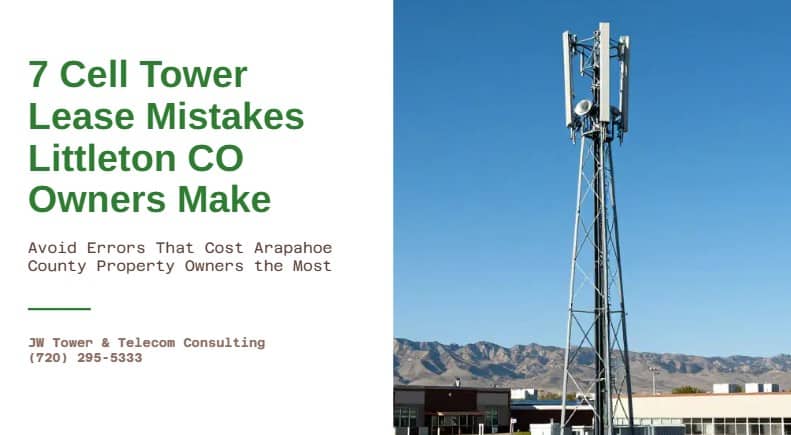
Understanding the 7 cell tower lease mistakes that Littleton, CO, property owners make is useful before a carrier contacts you, during negotiations, and at every renewal. Many of these mistakes feel like reasonable decisions when they’re made — and only reveal their cost over the 25–30-year life of the agreement, by then it’s too late to reverse them.
Mistake 1 — Treating the Initial Offer as the Starting Point Instead of the Floor
Carriers present initial lease offers at the market rate. In Littleton and Arapahoe County, that framing is designed to anchor the negotiation at a number that carriers know many unrepresented property owners will accept. The initial offer is not the market rate — it is the rate that the market has historically accepted without pushback. The market rate with professional representation is meaningfully higher for any site with genuine network necessity. Treating the carrier’s first number as a starting point rather than a floor is the foundational error from which all other mistakes follow.
Mistake 2 — Signing an Option Agreement Without Reviewing Its Terms
Option agreements — short documents that give the carrier the right to finalize a lease on your property — are frequently presented early in the process as routine administrative documents. They are not routine. Many option agreements contain pre-agreed lease terms (rent, escalation, equipment footprint) that become the baseline for the final lease. Signing an option that pre-agrees to below-market rent or broad equipment rights often locks in those terms before the “real negotiation” the property owner believed would happen later has actually occurred. Every option agreement deserves independent review before signing.
Mistake 3 — Accepting Weak Escalation Clauses
A 1.5% annual escalation versus a 3% annual escalation on a $2,000 monthly Littleton cell tower lease compounds to a total payment differential of over $400,000 over a 25-year term. Carriers present low escalation as standard and non-negotiable. It is neither. Escalation is one of the most important financial levers in any cell tower lease, yet most unrepresented Littleton property owners fail to negotiate it because they focus on the base rent number.
Mistake 4 — Allowing an Undefined Equipment Footprint
Initial lease drafts frequently describe the carrier’s equipment area in broad terms — “a ground lease area of approximately X square feet” or rights to “all equipment necessary for the carrier’s operations.” Without specific, defined limits on equipment footprint and height, the carrier can expand the equipment compound over time without additional compensation. In Littleton, where many cell tower locations are on commercial or mixed-use properties where the equipment compound location matters to property use, an undefined footprint can constrain future development or redevelopment.
Mistake 5 — Missing the Right of First Refusal Clause
Right-of-first-refusal clauses — buried in cell tower leases — give the carrier the right to match any purchase offer if the property owner decides to sell. This provision effectively reduces the property’s market value (buyers are deterred by the carrier’s ability to disrupt a sale), complicates financing (lenders may have concerns), and limits the owner’s flexibility to exit the property at will. Most Littleton property owners with this clause in their lease don’t realize it’s there until they try to sell. It is negotiable and should be removed.
Mistake 6 — Not Requesting Collocation Revenue Sharing
Tower operators routinely sublicense cell sites to multiple carriers — a practice called collocation. When a second carrier adds equipment to a structure built on your property, you may receive nothing unless your lease specifically requires the primary carrier to share sublicense revenue with you. Collocation revenue sharing is not automatically included in carrier-drafted leases. It must be negotiated and inserted as a specific provision. Many Littleton property owners whose towers host two or three carriers receive income from only one lease.
Mistake 7 — Treating Lease Renewal as Automatic Instead of as a Negotiation
When a cell tower lease approaches its initial term end, many Littleton property owners allow the renewal to proceed automatically on existing terms — sometimes because the carrier quietly exercises the renewal option before the property owner realizes the window has passed. Lease renewal is the most powerful moment of leverage a property owner will encounter after the initial signing: the carrier has now invested in the site (tower construction, equipment installation, network integration), and removing the tower is expensive and disruptive to their network. A well-timed renewal negotiation should reset rent to current market highs and improve provisions that were unfavorable in the original agreement. Treating renewal as a formality leaves significant money on the table. Call (720) 295-5333 for a free consultation.
Frequently Asked Questions
What is the single most costly mistake a Littleton, CO, property owner makes on a cell tower lease?
Accepting the initial offer without understanding the network value of their specific location. Carriers present initial offers at the standard market rate, which obscures that the number is based on what comparable Arapahoe County properties have historically accepted without representation. At sites with a genuine coverage-gap necessity, the gap between the initial offer and the well-negotiated value can be 30–60% on base rent alone.
Can I negotiate a cell tower lease that has already been signed in Littleton, CO?
Once signed, the primary negotiation opportunities are at renewal — the most important leverage window most property owners miss. Before renewal, JW Tower & Telecom Consulting helps Littleton property owners reset rent to current market, improve escalation clauses, and remove harmful provisions from the original agreement. Renewal is a full renegotiation opportunity. Call (720) 295-5333.
About the Author
John M. Wabiszczewicz II is the founder of JW Tower & Telecom Consulting in Denver, Colorado. He holds a Juris Doctor from Roger Williams University School of Law (Bristol, Rhode Island) and a Bachelor of Science in Finance from Bentley University (Waltham, Massachusetts). John began his telecommunications career in 2007 at American Tower as an Asset Acquisitions Attorney in Greater Boston, negotiating lease extensions, capital leases, perpetual easements, and land purchases on the most strategically important cell site locations nationwide with annual spend exceeding $40 million. In 2010, he relocated to Colorado and became a Tower Acquisitions Representative for American Tower, where he acquired new cell tower assets, generating over $10 million in annual revenue. From 2013 through 2023, he led Regional Network Engineering and Real Estate for T-Mobile’s Denver Market, with operational responsibility across Colorado, Wyoming, South Dakota, Utah, Nebraska, and Kansas. He founded JW Tower & Telecom Consulting to represent property owners, drawing on the same insider knowledge he had previously applied on the carrier and tower company side. Review the firm’s BBB profile for business verification.