
Cell Tower Lease Year-End Decisions: Tax, Timing, and Carrier Budgets
Q4 is decision season in the cell tower lease industry, and most property owners never notice. Carrier capital budgets are closing. Buyout firms are pushing to hit year-end transaction targets. Tax-driven liquidity moves are being calendared. And the property owner who waits until January to think about any of this will have missed multiple windows that mattered.
The short answer: Three distinct forces create year-end decision points for cell tower leaseholders: tax treatment of lump-sum buyouts, carrier and tower company capital budget cycles, and estate or family office planning requirements. Each has a specific timing. The right decisions get made by October or November, not December 28. Call (720) 295-5333 before the year-end window closes.
This post walks through the three forces, the specific timing on each, and the decision checkpoints a property owner should hit before year-end.
Force 1: Tax Treatment of Lump-Sum Buyouts
A cell tower lease buyout is typically a capital transaction for federal tax purposes. The property owner sells the future stream of rent (or the lease easement itself) to a buyer in exchange for a lump sum. Depending on how the transaction is structured and the property owner’s specific situation, this may trigger capital gains treatment, ordinary income treatment, or a combination.
The year-end timing matters for several reasons.
Capital gains rate bracket management. Federal long-term capital gains are taxed at 0%, 15%, or 20% depending on taxable income. A property owner whose other income is near a bracket boundary can make different choices about closing a buyout in December versus January, depending on which year’s bracket produces the lower rate.
Offsetting other gains or losses. If a property owner has other investment losses in the current tax year, closing a buyout in the same year can offset the gains with those losses. Closing in the next year loses that offset.
Installment sale structuring. Some buyouts can be structured as installment sales, where the lump sum is paid over multiple years. This can spread the tax impact across multiple tax years, potentially keeping the property owner in a lower bracket in each year. Structuring an installment sale requires decisions to be made before the closing document is signed.
1031 exchange considerations. In certain situations involving underlying real estate, a transaction structure can be used that defers capital gains by rolling the proceeds into replacement property. This is complex, requires a qualified intermediary, and involves tight timing windows that are easier to hit with early-in-the-year planning than late-in-the-year scrambling.
These are tax-professional questions. A cell tower lease consultant’s role is to flag the timing considerations and deliver the transaction structure that gives the CPA or tax attorney the options they need. The actual tax advice comes from the licensed tax professional. The IRS Publication 544 on sales and dispositions of assets provides the underlying federal framework.
Force 2: Carrier and Tower Company Budget Cycles
Wireless carriers and tower companies run on annual capital budget cycles. Those cycles create specific windows when negotiations move faster or slower.
Q3 to early Q4 (July through October): carriers finalize the current year’s capital spend. Negotiations that start in this window often accelerate because the carrier’s site acquisition team has budget authority and specific deal targets to meet. Leases that close by early November sometimes get stronger terms because the carrier wants to deploy the budget before the fiscal year ends.
Late Q4 (November through December): most carrier capital budgets are frozen or substantially committed. New lease negotiations in this window often stall because the site acquisition team cannot access the budget until the new fiscal year. This is not universal; some carriers have rolling or continuation budgets. But the general pattern is a slowdown.
Q1 (January through March): new fiscal year budgets open. Site acquisition teams have fresh targets and fresh pressure to deploy. Negotiations that start in this window often receive accelerated attention, as teams are eager to book early-year wins.
Q2 (April through June): steady state. Normal negotiating dynamics, neither accelerated nor slowed by budget timing.
The practical implication: a property owner with a lease amendment request, an extension negotiation, or a buyout discussion can strategically choose the timing. Pushing to close before year-end works if the carrier is motivated to deploy remaining budget. Waiting for Q1 works if the carrier is currently budget-constrained and the property owner can afford to wait.
This is the kind of judgment call a consultant with recent carrier-side experience can make with confidence. John M. Wabiszczewicz II, founder of JW Tower & Telecom Consulting, led Regional Network Engineering and Real Estate at T-Mobile through 2023. He knows how the capital budget cycle actually works inside a carrier, including the difference between stated budget freezes and practical budget flexibility.
Force 3: Estate and Family Office Planning
Estate administration, trust distributions, and family office reallocations often operate on annual cycles, creating year-end pressure to close transactions.
Estate liquidation. Executors often target year-end for asset distributions, particularly when heirs are in different tax brackets or have competing liquidity needs. A cell tower lease held by an estate may need to be liquidated to a buyout firm or sold with the property before year-end to close the administration.
Trust reallocations. Irrevocable trusts, charitable remainder trusts, and similar vehicles often require annual reporting on asset composition and may need to reallocate before year-end to match their required distribution schedules.
Gift tax planning. Transferring a cell tower lease interest to heirs as a gift at the lease’s current market valuation can fit within annual gift tax exclusion planning. This requires a defensible valuation, which requires a lease review by a qualified consultant.
Family office annual rebalancing. Family offices managing multiple assets often target year-end for portfolio rebalancing. A cell tower lease that is underperforming within the portfolio may be identified for liquidation or restructuring at that point.
In each scenario, the common denominator is that a defensible written lease valuation is required to support the transaction. Producing that valuation takes 1 to 3 weeks for a straightforward lease and longer for complex multi-tenant sites. A property owner expecting a year-end estate or trust decision should commission the valuation by early Q4 to have it in hand when the decision is made.
The Year-End Timeline
Here is a practical timeline for property owners who want to make year-end decisions thoughtfully rather than in a last-minute scramble.
August and September: if there is any possibility of a year-end transaction (buyout, amendment, extension, renewal, estate distribution), engage a cell tower lease consultant for initial review. The initial consultation is free at success-fee firms. This sets the baseline.
October: if the decision is to pursue a transaction, initiate it. Contact the carrier or engage buyout firms if running a competitive bid process. Get paperwork flowing.
Early November: targets for closing within the current tax year need to be advanced. Transactions not materially progressed by early November generally cannot close by December 31.
Mid-November through December: closings for transactions that were initiated in October. New transactions starting in this window will push into Q1.
Late December: tax-driven closing sprints. Some transactions can close in the last two weeks of December with intensive coordination, but the friction is high, and the price used is typically lower.
The property owner who takes this seriously in August has options. The property owner who thinks seriously about it on December 15 is pressured into whatever transaction can be closed in two weeks, which is usually not the best transaction available.
What “Good Year-End Decisions” Actually Look Like
Consider four illustrative year-end decision patterns.
Pattern 1: The disciplined evaluator. A property owner holding a single cell tower lease. Engages a consultant in August for a baseline valuation. Concludes that the lease is well-structured and above market. Decision: hold. No year-end transaction. Saves time and hassle. Revisits the question next year.
Pattern 2: The estate executor. Estate with a cell tower lease among several assets. Needs to distribute value cleanly. Engages a consultant in September to conduct a valuation. Runs a competitive bid process in October among three qualified buyout firms. Highest bid accepted in early November. Closing completed by mid-December. Tax implications flowed through the estate return. Heirs receive distributable cash by January.
Pattern 3: The strategic negotiator. Property owner with an aging lease due for renewal in the following year. Engages a consultant in September. Recognizes that opening renewal discussions with the carrier in October, during the Q3 budget-flexibility window, produces better terms than waiting for the actual renewal date the following year. Negotiates and closes an extended lease with improved terms by late November.
Pattern 4: The tax-driven closer. Property owner with substantial investment losses in the current year. Wants to close a buyout to generate gains that can offset losses. Engages the consultant in early October. Consultant structures the transaction for year-end closing. CPA confirms tax treatment. Transaction closes by mid-December. Net tax impact is neutral or favorable.
In each pattern, the common thread is early engagement with a qualified consultant and a clear decision framework. The pattern to avoid is the December 15 panic call from an owner who just realized year-end is looming and wants to “get something done.”
Frequently Asked Questions
Can I actually close a cell tower lease buyout in December?
Yes, if the transaction was initiated in October or earlier. Complex transactions requiring title searches, surveys, and lender coordination rarely close in a two-week window. Simple transactions on clean title properties can close in 3 to 4 weeks.
Is there a tax benefit to closing before year-end?
Depends on the property owner’s specific situation. Some owners benefit from deferring the transaction to January; others from pulling it into December. A tax professional should evaluate the specific case. A consultant can structure the timing of the transaction to give the tax professional options.
What is the difference between a capital gain and ordinary income on a cell tower lease buyout?
This is a question for a tax professional. Generally, the sale of a long-term easement interest is treated as a capital gain at the federal level. Some structured transactions may be treated differently. State tax treatment varies. A qualified tax attorney or CPA should evaluate your specific situation.
Do carriers offer year-end incentives to close lease deals?
Sometimes, not always. Carrier site acquisition teams may have year-end deal targets that motivate them to accelerate. Not every team and not every year has this dynamic. A consultant with current carrier relationships can read the specific situation.
What if my lease renews automatically in December?
Automatic renewals are triggered under the terms specified in the existing lease. If the terms are favorable, allow the renewal to proceed. If terms are unfavorable, the renewal window is an opportunity to negotiate improvements before the renewal triggers. Timing matters: notice periods for declining renewal are specified in the lease, and missing them can lock in the renewal at existing terms.
Can I gift a cell tower lease to my children for tax planning?
Yes, with proper structuring. The transfer requires a defensible valuation, legal documentation, and coordination with estate planning professionals. This is a multi-professional engagement involving a consultant (for valuation), an estate attorney (for documentation), and a CPA (for gift tax reporting).
What happens if I start a year-end transaction but it does not close in time?
The transaction either pushes into Q1 or unwinds. Unwinding a partially completed transaction is more expensive and more friction-laden than never starting it. This is why early initiation matters.
Should I wait for the new year to start any transaction?
Depends on the specifics. If tax timing or estate planning requires this year, waiting is not an option. If there is no specific pressure, Q1 often produces better negotiating dynamics than late Q4. A consultant can recommend timing based on the specific situation.
Is there a year-end premium for rushed transactions?
Sometimes the premium is in favor of the buyer (who has more use on a rushed seller). Sometimes in favor of the seller (who has use on a buyer who needs to close a deal before year-end). A consultant reads the direction the use is flowing for a specific transaction.
How do I get started?
Send your lease, any amendments, and any offers or correspondence. The initial consultation is free. If year-end timing is relevant, engage before October to have options. Call (720) 295-5333 or use the contact page.
Specific Tax Considerations by Transaction Type
Different cell tower lease transactions produce different tax treatments, and the year-end timing implications vary accordingly.
Lease buyout (sale of perpetual easement): Usually capital gains treatment at the federal level. Long-term capital gains apply if the lease has been held more than one year, which is almost always the case for property owners considering a buyout. State capital gains treatment varies.
Lease amendment payment (one-time fee for adding equipment): Treatment depends on whether the payment is characterized as rent or as consideration for an easement expansion. This distinction affects whether the amount is ordinary income or capital gains. Transaction structuring at the drafting stage determines the tax treatment.
Lease extension signing bonus: Usually ordinary income. Some structures can allocate a portion to deferred rent and a portion to consideration for property rights. The allocation matters for tax purposes.
Gift of lease interest to heirs: Subject to gift tax if above the annual exclusion. Requires a defensible valuation. Strategic use can stack multi-year gift tax exclusions to transfer substantial value tax-efficiently.
The Calendar: A Disciplined Property Owner Follows
Property owners who treat their cell tower lease as a managed asset rather than a passive income stream follow a simple annual calendar.
January: review any amendments or renewals coming up in the year ahead. Flag decisions that will need external expertise.
April: tax filing season. Review the prior year’s lease income reporting with the tax professional. Identify any optimization opportunities for the current year.
July: if any transaction is contemplated for the year, initiate the consultant engagement. The free initial consultation establishes the baseline valuation.
October: execute transactions that were scoped in Q3. Carrier budget dynamics favor deals that close in this window.
December: close any remaining transactions. Finalize year-end reporting coordinated with the tax professional.
This calendar keeps the property owner ahead of the decision pressure rather than reacting to it.
Bottom Line
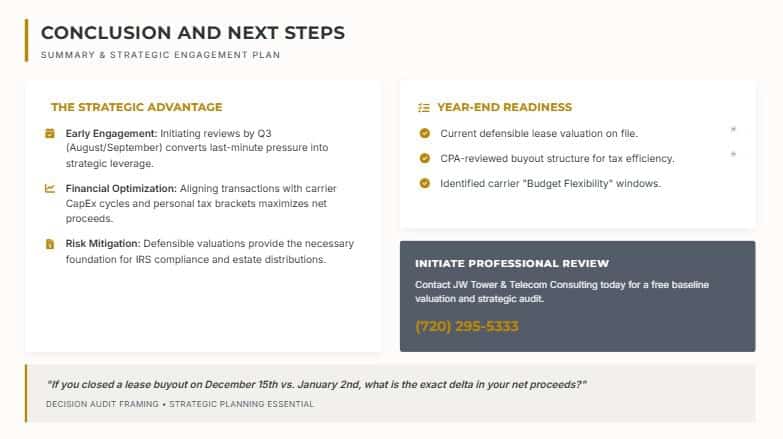
Year-end is decision season for cell tower leaseholders who know it is. Tax planning, carrier budget cycles, and estate requirements all create specific windows in which thoughtful action yields better outcomes than last-minute scrambling. The time to engage the consultant is August or September, not December.
For a free review of your specific situation and an honest read on whether year-end action makes sense for your lease, call (720) 295-5333 or use the contact page.
About the Author
John M. Wabiszczewicz II is the founder of JW Tower & Telecom Consulting in Denver, Colorado. Juris Doctor, Roger Williams University School of Law. Bachelor of Science in Finance, Bentley University. 5 years at American Tower. 10 years at T-Mobile, leading Regional Network Engineering and Real Estate for the Denver Market through 2023. Year-end carrier budget dynamics are familiar territory from a decade of watching fiscal-year-end deal sprints from the inside. Firm verification: BBB profile.