
HOA vs Commercial Cell Tower Leases in Centennial CO (2026)
HOA vs Commercial Cell Tower Leases Centennial
Understanding the difference between HOA and commercial cell tower leases in Centennial, CO, matters because Centennial’s large HOA community — a significant portion of one of Colorado’s most planned and aesthetically regulated cities — creates lease governance and risk considerations that commercial property owners don’t face. The financial negotiation runs parallel in both cases, but the structural requirements diverge significantly.
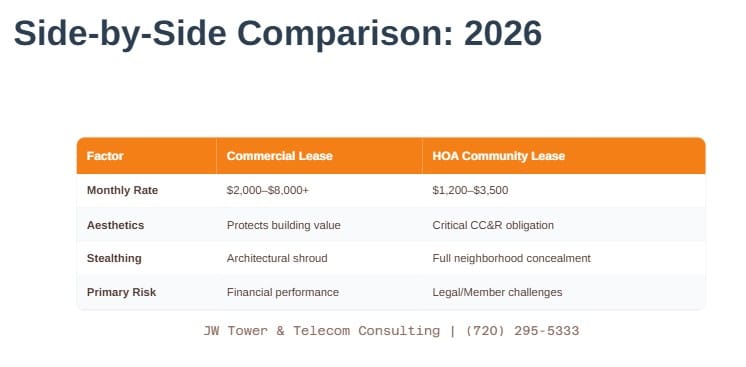
Side-by-Side Comparison — 2026
| Factor | Commercial Property Lease | HOA Community Lease |
|---|---|---|
| Value position (well-negotiated, Centennial) | Premium, DTC-adjacent highest | Varies with coverage necessity |
| Signatory authority | Property owner or authorized agent | Board must verify governing document authority – membership approval may be required |
| Aesthetic provisions required | Important – protects building value and appeal | Critical – HOA has ongoing CC&R obligations to members; failure = governance exposure |
| Stealthing standard | Architectural shroud matching building design | Full concealment to community standards; no visible deviation from neighborhood character |
| CC&R alignment requirement | Not applicable | All lease provisions must align with CC&Rs and architectural guidelines |
| Community notification | Not typically required | May be required depending on governing documents; transparency prevents member challenges |
| Revenue allocation | Goes to the property owner | Goes to HOA – board must determine how revenue is used consistent with governing documents |
| Most important negotiation priority | Rent (DTC) or renewal correction (first-wave) | Governance alignment first, then aesthetic provisions, then financial terms |
| Primary risk if poorly negotiated | Financial underperformance over the lease term | Legal exposure from member challenges + aesthetic obligation breach + financial underperformance |
The HOA Governance Layer — What Commercial Owners Don’t Face
Authority verification. Before an HOA board can execute a cell tower lease, the governing documents must be reviewed to confirm the board has authority to do so. Centennial HOA documents vary: some grant boards broad authority to license common areas; others require membership approval for long-term agreements, encumbrances on common areas, or agreements above specific dollar thresholds. An HOA board that signs a cell tower lease without confirming its authority creates a lease that members can challenge — potentially years into the agreement, after the carrier has installed equipment and the HOA has begun receiving rent.
CC&R aesthetic alignment. Centennial HOAs have CC&R obligations to their members regarding the community’s visual character. A cell tower lease that allows visible antenna structures inconsistent with the community’s architectural standards puts the HOA board in breach of its CC&R obligations. An HOA that signs a lease without aesthetic provisions — stealthing requirements, height restrictions, equipment concealment standards — may face member complaints, enforcement demands, and potential litigation long after the carrier’s equipment is in place. These provisions must be in the lease, not added afterward.
Revenue allocation governance. When an HOA receives cell tower lease income, the board must determine how to allocate that revenue in a manner consistent with the governing documents. Cell tower income cannot simply be distributed to individual homeowners; it typically flows into the HOA’s operating or reserve accounts. The governing documents determine how this is handled. Understanding the revenue allocation structure before signing is part of the governance review that every Centennial HOA board should conduct.
What Commercial Centennial Leases Must Prioritize
For commercial property owners — office buildings near the DTC, retail centers like SouthGlenn, mixed-use properties along the I-25 corridor — the priority structure is financial: maximizing base rent (especially for DTC-adjacent sites with above-market network value), securing strong escalation (set to the network value of high-value Centennial commercial sites), adding colocation revenue sharing, and removing the right of first refusal that reduces building market value. Aesthetic provisions matter for commercial properties — stealthing requirements protect building appeal — but they don’t carry the governance-obligation weight they carry for HOAs.
JW Tower & Telecom Consulting handles both HOA and commercial Centennial cell tower leases. Call (720) 295-5333 for a free consultation.
Frequently Asked Questions
Can an HOA board sign a cell tower lease in Centennial, CO?
It depends on the HOA’s governing documents. Some Centennial HOA boards have full authority; others require membership approval. A governing document review is essential before any HOA board engages with a carrier offer. Call (720) 295-5333 for a consultation that includes an HOA governance review.
Do HOA cell tower leases in Centennial, CO, require different stealthing provisions than commercial leases?
Yes — typically more extensive ones. Commercial stealthing protects building aesthetics. HOA stealthing must also protect CC&R obligations and community aesthetic standards that the HOA is legally required to maintain. Stealthing provisions for Centennial HOA leases must be specific, restrictive, and binding on any carrier successor. Call (720) 295-5333.
About the Author
John M. Wabiszczewicz II is the founder of JW Tower & Telecom Consulting in Denver, Colorado. He holds a Juris Doctor from Roger Williams University School of Law (Bristol, Rhode Island) and a Bachelor of Science in Finance from Bentley University (Waltham, Massachusetts). John began his telecommunications career in 2007 at American Tower as an Asset Acquisitions Attorney in Greater Boston, negotiating lease extensions, capital leases, perpetual easements, and land purchases on the most strategically important cell site locations nationwide with annual spend exceeding $40 million. In 2010, he relocated to Colorado and became a Tower Acquisitions Representative for American Tower, where he acquired new cell tower assets, generating over $10 million in annual revenue. From 2013 through 2023, he led Regional Network Engineering and Real Estate for T-Mobile’s Denver Market, with operational responsibility across Colorado, Wyoming, South Dakota, Utah, Nebraska, and Kansas. He founded JW Tower & Telecom Consulting to represent property owners, drawing on the same insider knowledge he had previously applied on the carrier and tower company side. Review the firm’s BBB profile for business verification.