
How W Line Light Rail Affects Cell Tower Leases Lakewood
W Line Light Rail Lakewood
Understanding how the W Line light rail affects cell tower lease value in Lakewood, CO, matters to every property owner within proximity of the seven W Line stations operating within Lakewood city limits — because that proximity, in carrier network planning terms, is a measurable asset that most property owners never use in their lease negotiations.
What the W Line Created for Carrier Network Investment
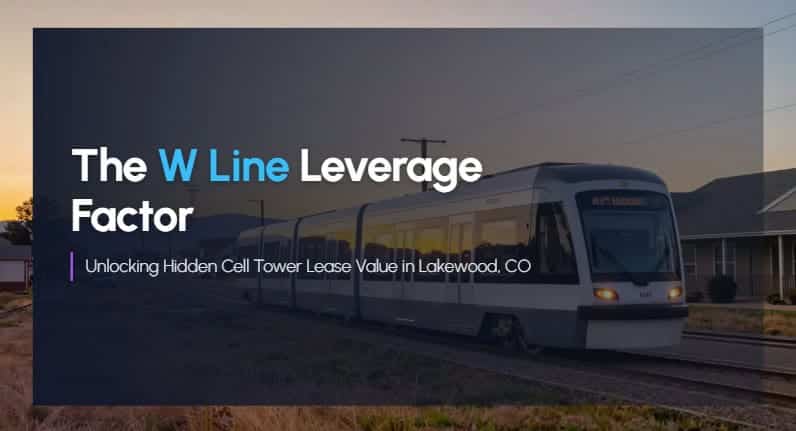
When the W Line opened in April 2013 — connecting Lakewood to downtown Denver along a 12.1-mile corridor — it created a predictable carrier network problem: a new transit infrastructure serving tens of thousands of daily commuters who expected seamless mobile service along the entire route. Carriers responded with targeted network investment in the W Line corridor, prioritizing coverage and capacity at each station and along the transit segments between them.
That investment did not happen once. It has continued for over a decade as the transit-oriented development triggered by the W Line has added residents, businesses, and mobile data demand along the entire Lakewood corridor. Seven stations within Lakewood city limits represent seven distinct demand nodes — and properties near those stations sit in carrier network investment priority zones that most property owners don’t realize carry above-average lease value.
The Seven W Line Stations in Lakewood and What They Mean for Cell Tower Leases
The seven W Line light rail stations operating within Lakewood create varying levels of carrier network demand depending on station ridership, transit-oriented development density, and surrounding land use. Key patterns:
Stations in areas of concentrated transit-oriented development — typically featuring mixed-use projects, apartment density, and commercial activity that has clustered around the station since 2013 — have the highest demand density and the greatest priority for carrier network investment. Properties near these stations in Lakewood have above-average lease leverage, based on the density of mobile demand they serve.
Stations in corridors connecting residential Lakewood neighborhoods to the Denver commuter network carry consistent daily commuter demand that carriers prioritize for capacity. Morning and evening peak commute periods create concentrated mobile usage at these stations, which carriers specifically fund in their network capacity plans.
Stations near major Lakewood employers or institutions — including the Denver Federal Center area and major healthcare facilities — experience additional demand from employee and visitor mobile usage that layers on top of transit ridership.
How Property Owners Near W Line Stations Should Use This Leverage
The W Line proximity factor affects cell tower lease negotiations in three specific ways:
Base rent justification. When a carrier offers a Lakewood property owner a “standard Jefferson County market rate,” the W Line proximity factor is a specific data point that justifies a premium above that standard. Carriers know the transit corridor value is there — they’ve priced it into their internal network budget. An informed negotiator surfaces it explicitly rather than accepting the carrier’s generic market rate framing.
Multi-carrier colocation likelihood. Transit corridor sites in Lakewood are more likely than standard residential sites to attract multiple carriers seeking coverage in the same high-demand zone. A lease that doesn’t include collocation revenue-sharing provisions means a property owner receives no additional income when a second or third carrier adds equipment. W Line-adjacent sites should include this provision as a standard negotiation item.
Renewal leverage. A carrier who has invested in a site near a W Line station has invested in a network node serving a specific, durable demand source — the transit corridor. That investment makes the carrier highly motivated to retain the site at renewal. Property owners near W Line stations have above-average renewal leverage because the carrier has more to lose from abandoning the site than from accepting a higher renewal rent.
What This Means for Your Lakewood Property
JW Tower & Telecom Consulting evaluates W Line proximity as a specific component of every Lakewood lease network value assessment — incorporating station proximity, transit corridor investment history, and transit-oriented development density accumulated since 2013 into the negotiation position. This is insider knowledge from the period when John Wabiszczewicz was managing T-Mobile’s Front Range network investment — including the Jefferson County market during the W Line densification period. Call (720) 295-5333 for a free assessment of your Lakewood property’s W Line proximity value.

Frequently Asked Questions
Which W Line light rail stations in Lakewood, CO, are most relevant to cell tower lease value?
All seven W Line stations within Lakewood create transit corridor network demand. Stations with higher ridership, transit-oriented development concentration, or proximity to major employers carry greater leverage. JW Tower & Telecom Consulting evaluates W Line proximity as a specific component of every Lakewood lease assessment. Call (720) 295-5333.
How long has the W Line light rail affected demand for cell towers in Lakewood, CO?
The W Line opened in April 2013, triggering an immediate response in carrier network investment that has continued for over a decade as transit-oriented development has added residents and businesses along the corridor. W Line proximity is a durable leverage factor — not a temporary market condition.
What is transit corridor densification, and why does it affect Lakewood cell tower lease rates?
Transit corridor densification — the pattern of increased population density and commercial activity following transit investment — raises demand for mobile data in transit-adjacent zones. Carriers invest in network capacity proportional to that demand, assigning higher priority and budget to coverage in those areas. Lakewood property owners near W Line stations sit in carrier-network investment-priority zones that translate directly into leverage in negotiations.
About the Author
John M. Wabiszczewicz II is the founder of JW Tower & Telecom Consulting in Denver, Colorado. He holds a Juris Doctor from Roger Williams University School of Law (Bristol, Rhode Island) and a Bachelor of Science in Finance from Bentley University (Waltham, Massachusetts). John began his telecommunications career in 2007 at American Tower as an Asset Acquisitions Attorney in Greater Boston, negotiating lease extensions, capital leases, perpetual easements, and land purchases on the most strategically important cell site locations nationwide with annual spend exceeding $40 million. In 2010, he relocated to Colorado and became a Tower Acquisitions Representative for American Tower, where he acquired new cell tower assets, generating over $10 million in annual revenue. From 2013 through 2023, he led Regional Network Engineering and Real Estate for T-Mobile’s Denver Market, with operational responsibility across Colorado, Wyoming, South Dakota, Utah, Nebraska, and Kansas. He founded JW Tower & Telecom Consulting to represent property owners, drawing on the same insider knowledge he had previously applied on the carrier and tower company side. Review the firm’s BBB profile for business verification.