
Cell Tower Lease Negotiation: DIY vs Hiring a Consultant
Negotiating your own cell tower lease looks doable. You are smart. You have successfully negotiated other business deals in your life. You can read a 30-page document. You can send a polite counter-email requesting a lower rent. What could be hard about it?
The short answer: DIY negotiation of a cell tower lease produces a worse outcome in almost every case, and the gap between DIY and consultant-led outcomes is usually measured in six figures over the life of the agreement. This post walks through the exact reasons why, with the math. For a free read on where your specific situation lands, call (720) 295-5333.
The question is not whether a property owner is smart enough to negotiate a cell tower lease. Most are. The question is whether the asymmetry of experience makes DIY a rational choice even for a smart owner. The data says it does not, for reasons that have nothing to do with intelligence and everything to do with structural information gaps.
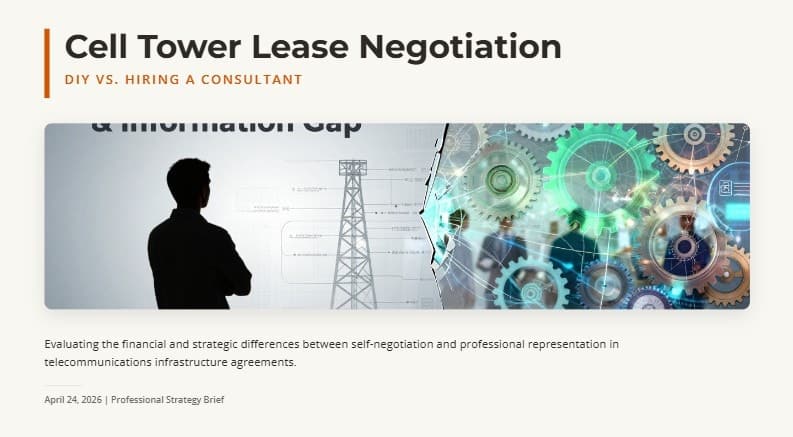
The Information Gap
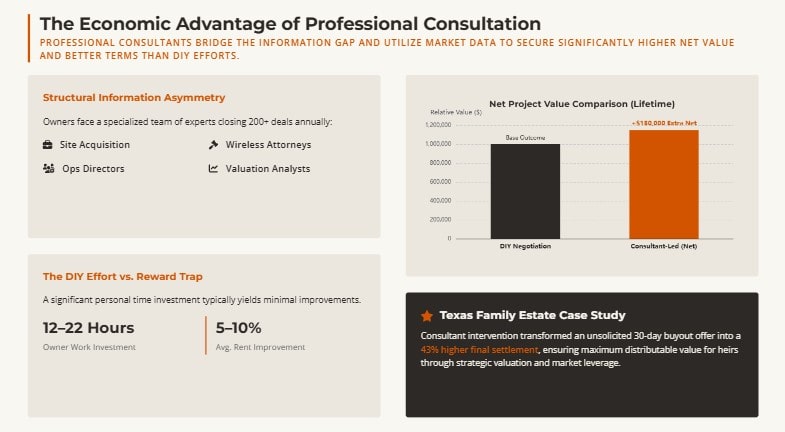
A property owner negotiating their own cell tower lease is competing against a team on the other side that includes:
- A site acquisition specialist who has closed 200+ similar deals
- A real estate attorney whose entire practice is wireless infrastructure
- An operations director whose budget is tied to getting the lease signed at Target Economics
- A valuation analyst with access to every comparable transaction in the relevant market
- A management approval chain that has pre-authorized specific give-and-take positions
The property owner has their own intelligence, and they can do their own research online in a few hours. The carrier or tower company has a team that spends its professional life on this one category of transaction. The asymmetry is structural, and no amount of smart reading closes it.
You negotiate one cell tower lease in your life. They negotiate thousands. This is the whole game.
What DIY Actually Looks Like in Practice
A property owner attempting to negotiate their own lease usually follows this pattern.
Step 1: Read the lease carefully. Take notes. Identify the terms that feel unreasonable. Develop a mental list of changes to request. This step usually takes 4 to 8 hours of focused work.
Step 2: Research online. Read a few articles about cell tower leases. Learn some terminology. Discover that certain clauses (Right of First Refusal, escalator structure) matter more than others. This step adds 4 to 8 more hours.
Step 3: Draft a counteroffer. Request a higher rent, a better escalator, and perhaps the removal of one or two clauses that seem one-sided. Send the counter to the carrier’s site acquisition representative. 2 to 4 hours.
Step 4: Receive a polite partial concession. The carrier agrees to improve one or two items by modest amounts. They explain that the remaining items are “not negotiable” or “part of our standard form.” The counter-offer feels like progress. 2 hours of phone calls and emails.
Step 5: Sign. The property owner feels they successfully negotiated and walks away with a lease that is modestly better than the opening offer. Transaction closes.
Total time invested: 12 to 22 hours. Total improvement over the opening offer: usually 5% to 10% on the rent number, plus one or two minor clause adjustments. That improvement sounds fine until compared against what a qualified consultant would have delivered in the same scenario.
What Consultant-Led Negotiation Looks Like
A consultant-led engagement on the same lease usually produces a different outcome because the consultant approaches the negotiation with different tools.
First, the consultant has access to actual comparable transaction data. They know what carriers are paying in the specific county and for the specific site category. The property owner knows only what the internet tells them, which is usually a 5-year-old average that bears little resemblance to the current market.
Second, the consultant knows which clauses are genuinely non-negotiable from the carrier’s side and which ones will move with the right counterproposal. The property owner does not. The DIY negotiator asks for improvements on items the carrier was never going to concede, exhausts the negotiating budget, and does not know how to ask for improvements on items the carrier could have conceded if pushed.
Third, the consultant knows the carrier’s internal approval process. They know that a counterproposal framed one way will be rejected at the first level of review, and the same economic ask, framed differently, will be approved. The property owner does not see this distinction. DIY counters often fail not because the ask was unreasonable but because the framing triggered a rejection at a level that could not approve it.
Fourth, the consultant has negotiated with the property owner, but the owner has not. A consultant with a reputation for walking away from lowball offers or for bringing in competing bids when the carrier is slow to move has real value. A property owner with no walk-away option and no alternative buyer signaled is negotiating from a position of weakness.
The typical consultant-led outcome on the same lease improves the rent number by 15% to 30%, improves the escalator structure, removes or tightens the Right of First Refusal clause, and addresses two to four additional clauses. The aggregate lifetime value difference over DIY is usually $100,000 to $400,000+ on a mid-market lease.
The Cost Comparison
Here is where the DIY math actually breaks.
DIY cost: 12 to 22 hours of the property owner’s time at the owner’s hourly rate. Plus, the lifetime cost of accepting terms that could have been improved. On a typical mid-market lease, the uncaptured value is $100,000 to $400,000 over the lease term.
Consultant cost (success-fee structure): No upfront cost. Initial consultation free. The success fee is a percentage of the incremental value secured, typically 25% to 35%. If the consultant delivers $200,000 in additional lifetime value, the fee is $50,000-$70,000. The property owner keeps $130,000 to $150,000 of improvements they would not have captured on their own, plus the time they did not spend on DIY.
The math strongly favors consultant-led negotiation when a meaningful gap exists between the opening offer and the fair market. It favors DIY only when (a) the opening offer is already close to fair market, in which case a consultant’s free initial review confirms this and produces no further engagement, or (b) the property owner genuinely has more insider knowledge than the carrier’s team, which is a narrow set of owners.
When DIY Actually Works
Two narrow scenarios where DIY is a reasonable choice.
Scenario 1: The property owner is themselves a wireless industry professional. If the owner has worked inside a carrier’s site acquisition team, a tower company’s leasing group, or a wireless real estate firm for several years, they may have the direct knowledge to negotiate successfully. This is a small population.
Scenario 2: The transaction is genuinely low-stakes. A minor amendment request (carrier adds one small antenna in exchange for a small one-time payment) may not justify the overhead of a formal engagement. A consultant’s free initial review can quickly confirm this.
For everything else (new leases, material amendments, renewals at term-end, any buyout offer), consultant-led negotiation is the economically rational choice.
The Hidden Cost of DIY: Mental Bandwidth
The DIY path costs more than the dollar gap. It costs months of mental bandwidth. A property owner negotiating their own lease spends weeks reading, researching, drafting, revising, and following up. That bandwidth could have been spent on the property owner’s actual business, family, or other priorities.
Outsourcing the negotiation to a specialist frees that bandwidth. The property owner retains the final decision-making authority on every proposal. What they delegate is the work of researching, drafting, and pushing back, not the decision-making. For most property owners, the bandwidth recovery is itself worth more than the consultant’s fee.
A Real Case Study
Consider the Texas family case study documented on the JW Tower site. The family inherited a cell tower lease as part of an estate. An unsolicited buyout offer arrived with a 30-day response window. The estate administrator had two paths available.
DIY path: review the offer internally, perhaps consult the family’s general-practice attorney for a legal check, and decide whether to accept or counter. In estate situations with multiple heirs and emotional dynamics, this path typically leads to acceptance of the initial offer, closing the matter quickly.
Consultant path: engage JW Tower & Telecom Consulting for an independent valuation and negotiation. This path added 60 to 90 days to the timeline. It also produced a 43% higher buyout than the initial offer. On a transaction with this magnitude, the consultant fee was a small fraction of the improvement delivered. The heirs received more distributable value, the estate closed cleanly, and the process was documented for future reference.
The Texas family case is not an outlier. It is representative of what happens when a DIY comparison is run against a consultant-led alternative on a meaningful transaction.
The U.S. FCC’s Competition and Infrastructure Policy Division publishes the macro-level wireless infrastructure economics that explain why these deals have structural margin for consultants to capture on behalf of property owners. That margin is a feature of the market, not an accident.
Frequently Asked Questions
Can I negotiate my own lease and still bring in a consultant later?
Possible but harder. Once a counteroffer has been made and rejected, the negotiating position has been anchored. A consultant engaged later starts from a weaker anchor. Engaging the consultant at the start of the negotiation produces better outcomes than engaging them mid-negotiation.
Is a consultant always worth the fee?
No. If the opening offer is genuinely close to fair market, a consultant’s initial review confirms this and produces no further engagement. The free initial consultation is the mechanism for determining whether an engagement makes economic sense.
What if I want to negotiate hard but am nervous about hurting the relationship with the carrier?
This is a common concern. Carriers and tower companies have multi-generational relationships with thousands of property owners. They do not hold grudges against owners who negotiate. They expect negotiation. What they respect is a represented owner who negotiates efficiently. Hiring a consultant does not damage the relationship; it usually improves it because the communication becomes more professional.
Can I observe the negotiation if I hire a consultant?
Absolutely. JW Tower & Telecom Consulting keeps property owners copied on all substantive communications and consults on every material decision. The consultant handles the tactical work; the owner retains strategic oversight.
How long does a consultant-led negotiation take?
Typically, 30 to 90 days for lease amendments and new lease negotiations. Buyouts can take 3 to 6 months for complex transactions with title, survey, and lender coordination. Simple second-opinion reviews take about a week.
What if I have already started DIY and want to bring in a consultant now?
Still possible, and often still worthwhile. Send the consultant the current state of the negotiation: what has been offered, what you have countered, and what the carrier has said. The consultant can assess whether the current position can still be improved and what an engagement would look like going forward.
Are some carriers more negotiable than others?
Yes. The major carriers (Verizon, AT&T, T-Mobile) have different internal processes and different negotiating flexibility. The major tower companies (American Tower, Crown Castle, SBA Communications) also vary. A consultant who has worked inside multiple carriers and tower companies knows which counterparties move on which issues.
What if my lease is small (low rent)?
Consultant economics still works. Success-fee engagements scale to the transaction. A small lease produces a small fee proportional to a small improvement. The math can still favor engagement if the potential for improvement is meaningful.
Can I use online “cell tower lease calculator” tools?
Most publicly available calculators rely on outdated assumptions and fail to account for site-specific variables such as colocation potential, equipment type, local market conditions, or carrier-specific valuation models. They produce ballpark estimates that are usually wrong by a meaningful margin. Use them as a sanity check, not as a benchmark.
How do I get started?
Send the lease and any correspondence you have received. Initial review is free. Call (720) 295-5333 or use the contact page.
The Negotiation Dynamics DIY Misses
Beyond raw information, consultant-led negotiation adds specific tactical dynamics that DIY cannot replicate. A consultant can credibly signal that the property owner has alternative buyers or alternative strategies (walk away, wait for the next renewal cycle, run a competitive bid process). A property owner negotiating alone has no credible walk-away option because the carrier knows the owner has limited alternatives.
A consultant can also credibly signal patience. The consultant’s income is not tied to closing this specific deal this specific quarter. A property owner often feels psychological pressure to close quickly because the negotiation is emotionally exhausting. That pressure telegraphs to the carrier, weakening the negotiating position.
A third dynamic is escalation paths. When a DIY negotiation hits an impasse with the carrier’s front-line site acquisition representative, the property owner has no natural escalation path. A consultant with industry relationships can often escalate issues through channels the front-line representative does not control, sometimes reopening issues that appeared closed.
What to Do If You Truly Prefer DIY
For property owners who genuinely prefer to handle their own negotiation despite the math, there is a middle path: engage a consultant for the initial assessment and strategic recommendations, then execute the negotiation yourself with the benefit of that foundation. Some consultants offer this limited-scope engagement at reduced fees. The property owner gets the strategic framework, the specific clause-level analysis, and the market benchmarking, then handles the tactical negotiation. This captures most of the upside of consultant-led negotiation at a fraction of the cost and preserves the owner’s hands-on involvement.
This model works best when the property owner has negotiation experience in other contexts (commercial real estate, business acquisitions, employment contracts) and simply lacks industry-specific knowledge. The consultant provides the missing industry knowledge; the owner provides the execution of negotiations.
Bottom Line
DIY negotiation of a cell tower lease rarely produces a result that justifies the time invested. The structural information gap between a property owner and the carrier’s team means that even a smart, well-prepared owner typically captures only 5% to 10% of the available improvement in the rent number and misses most clause-level improvements entirely. A consultant-led engagement on a success-fee structure typically delivers a 15% to 30%+ improvement, the fee is paid out of the improvement, and the net outcome to the property owner is materially better.
For a free read on your specific situation and an honest assessment of whether DIY or consultant-led makes sense, call (720) 295-5333 or use the contact page. Related: see our post on 10 questions to ask a cell tower lease consultant before engaging.
About the Author
John M. Wabiszczewicz II is the founder of JW Tower & Telecom Consulting in Denver, Colorado. Juris Doctor, Roger Williams University School of Law. Bachelor of Science in Finance, Bentley University. 5 years at American Tower. 10 years at T-Mobile, leading Regional Network Engineering and Real Estate for the Denver Market across 6 states. He founded JW Tower & Telecom Consulting to close the information gap that makes DIY negotiation so costly for property owners. Firm verification: BBB profile.